Custom Paper Cups: A Buyer's Guide for Cafes and Food Brands
Custom paper cups may look like a simple packaging purchase, but the details affect much more than appearance. The wrong size can throw off recipe costs, an incompatible lid can slow down service, and artwork that looks perfect on a screen may become difficult to read once it is wrapped around a tapered cup.
For cafes and food brands, the best custom paper cup is the one that fits the complete serving system: the drink, portion size, lid, sleeve, equipment, service time, artwork, and order volume.
This guide explains how to compare custom paper cups before ordering, what to test with samples, and which questions to ask your packaging supplier.
The Short Answer: How Should You Choose Custom Paper Cups?
Start with your menu—not your logo.
For each drink, define:
- The finished serving volume, including milk, ice, foam, and toppings.
- Whether the drink is served hot, cold, or both.
- The required wall construction and whether a sleeve may be needed.
- The exact lid style and fit.
- How customers carry or transport the drink.
- How many cups you realistically use per size.
- The artwork, colors, and information that must remain readable.
Once those requirements are clear, request samples and test the complete cup-and-lid combination under real service conditions. Only approve production after checking fit, handling, print placement, and drink performance.
Choose Cup Sizes Around Your Actual Menu
Cup size is one of the first decisions buyers make, but labeled capacity alone does not tell the whole story. A 12 oz black coffee and a 12 oz iced latte place different demands on a cup because ice, foam, and toppings change usable volume.
Ecoally’s current custom paper cups with lids are offered in 8 oz, 12 oz, and 16 oz capacities. These sizes can cover a practical range of cafe and takeaway beverage programs, but the best combination depends on your recipes.
| Cup size | Common starting use cases | Questions to test before ordering |
|---|---|---|
| 8 oz | Small coffee, flat white, tea, sample-size beverages | Does the finished recipe leave enough headspace? Is the cup comfortable for a hot drink without an added sleeve? |
| 12 oz | Standard coffee, latte, cappuccino, tea, medium takeaway drinks | How much capacity remains after milk, foam, or ice? Does it fit your machine and cup dispenser? |
| 16 oz | Large coffee or tea, larger cold beverages, specialty drinks | Is the cup stable when full? Will customers need a sleeve or carrier? Does your chosen lid suit the drink? |
Treat these as starting points rather than universal rules. Before finalizing sizes, prepare every core menu item exactly as staff would serve it. Check the fill line, headspace, visual presentation, lid clearance, and cost per finished drink.
Keeping the number of cup sizes manageable can also simplify inventory. If one cup size can support several recipes without compromising portion control, you may reduce storage needs and avoid splitting orders across too many configurations.
Hot and Cold Drinks Have Different Requirements
A supplier may describe a paper cup as suitable for hot and cold beverage service, but buyers should still test it with the exact drinks they sell.
For hot drinks, evaluate:
- How the cup feels at your normal serving temperature
- Whether a sleeve is required for comfortable handling
- How the sidewall performs during the expected holding time
- Whether the lid remains secure after filling
- Whether steam or pressure affects the drinking opening
- How the filled cup behaves in a carrier or delivery bag
For cold drinks, consider:
- Ice displacement and remaining usable volume
- Exterior condensation during the expected service period
- The customer’s grip when the outside becomes damp
- Whether the supplied lid opening suits the drink
- Clearance for foam, whipped toppings, or other additions
- Stability during takeaway and delivery
Ecoally’s current product listing describes its paper cups as intended for hot and cold beverage service. However, the included lids are described as matching sip lids. If your cold drinks require a straw slot, flat cold-cup lid, or domed lid for toppings, confirm availability and compatibility before ordering.
Never assume that two lids are interchangeable simply because the cups have the same labeled capacity.
Single-Wall vs. Double-Wall Paper Cups
Wall construction affects handling, storage, appearance, and whether a separate sleeve may be needed.
Single-Wall Cups
A single-wall cup uses one primary paperboard wall. It can be a practical option when compact storage and efficient service are priorities. Depending on drink temperature, service time, and cup specification, a sleeve may be appropriate.
If you are ordering custom paper coffee cups for hot drinks, test single-wall samples using your real beverage temperatures. Staff familiarity is not a substitute for customer testing: a cup that feels acceptable during a quick counter handoff may feel different during a longer walk or delivery journey.
Double-Wall Cups
A double-wall construction adds an outer layer and can provide additional separation between the beverage and the customer’s hand. It also creates a different printing surface and may have different storage requirements.
On Ecoally’s current listing, construction is fixed by size:
- 8 oz: double-wall
- 12 oz: single-wall
- 16 oz: single-wall
Wall construction is not shown as a separate selectable option on that product. If your program requires a different construction—for example, a 12 oz double-wall cup—contact the supplier before assuming it can be produced through the standard listing.
Ecoally also offers custom coffee cup sleeves, but cup and sleeve compatibility should be checked with physical samples.
Cup Material and Barrier Questions to Ask
Paper beverage cups generally require a liquid-resistant inner barrier, but barrier materials and constructions vary. They can affect performance, end-of-life options, and local waste handling.
Ask the supplier for the specification relevant to your order, including:
- Paper source and material composition
- Inner barrier or lining type
- Intended beverage applications
- Any temperature or holding-time limitations
- Applicable food-contact documentation for your sales market
- Storage recommendations
- Available recycling or disposal guidance
Ecoally’s current product page lists the cup material as recycled wood-pulp paper. Do not translate that description into a universal environmental claim. Whether a used paper cup can be recycled depends on its complete construction, contamination, local collection rules, and capabilities of the receiving facility.
If an environmental claim matters to your brand, request supporting documentation for the exact cup configuration before adding that claim to packaging or marketing.
Lid Matching Is a Purchasing Priority
Lid problems create immediate operational problems. A loose lid can leak during handoff, while an overly tight lid may deform the cup rim or slow staff down during a rush.
Cup capacity does not determine lid fit. Two 12 oz cups from different systems may have different rim diameters or profiles. Match lids by the manufacturer’s cup specification, not by the ounce label alone.
A sample test should answer the following questions:
- Does the lid attach evenly around the entire rim?
- Can staff apply it quickly without excessive force?
- Does the rim deform while the lid is fitted?
- Does the lid remain attached when the filled cup is tilted normally?
- Is the drinking opening suitable for the beverage?
- Does the lid interfere with foam, toppings, or the intended fill level?
- Do stacked lids separate easily during service?
Ecoally’s standard paper cup listing includes matching black or white lids. The minimum order applies to each configuration of cup size and lid color, so plan variants carefully instead of creating unnecessary inventory combinations.
What to Know About Custom Printing
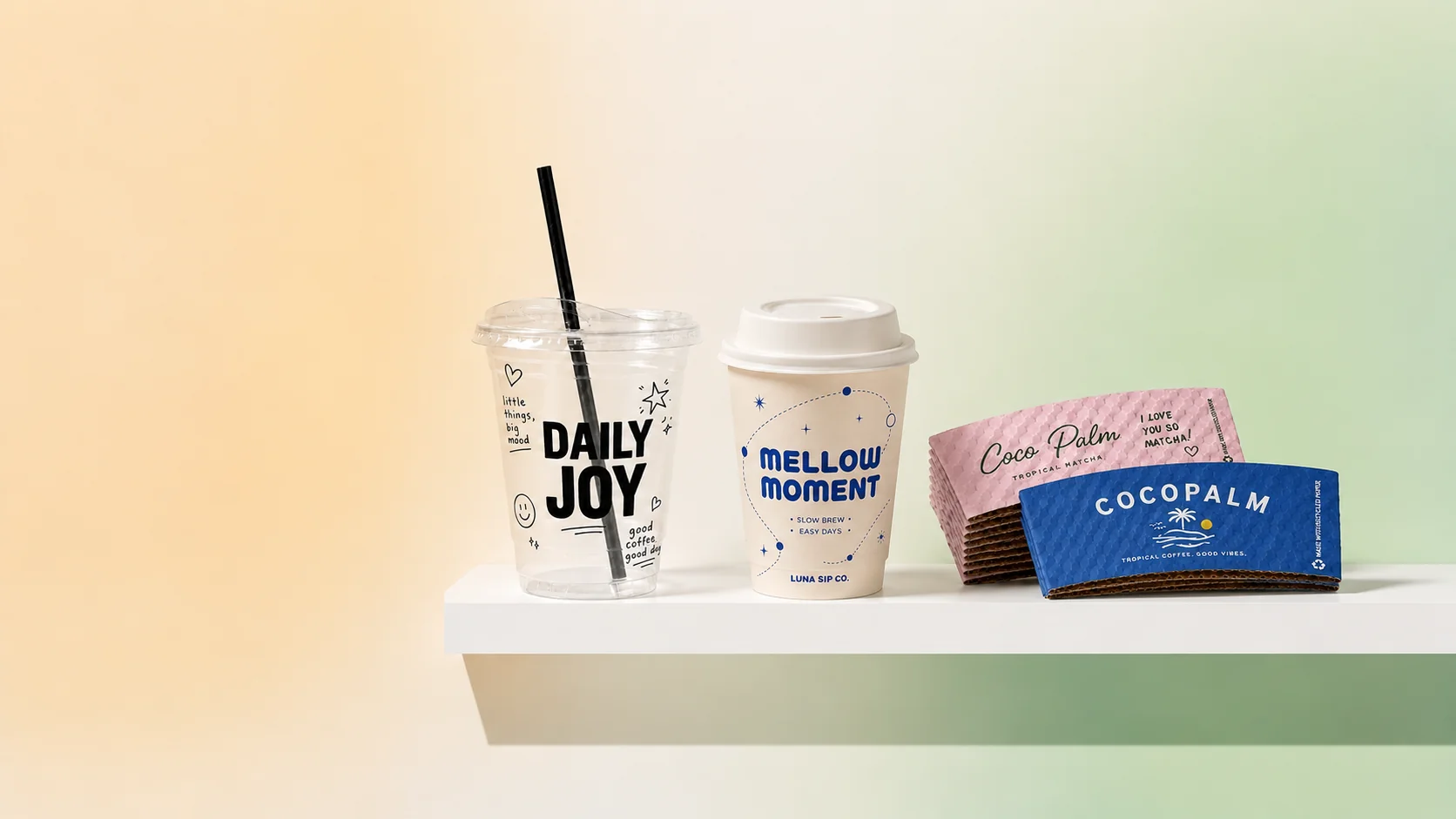
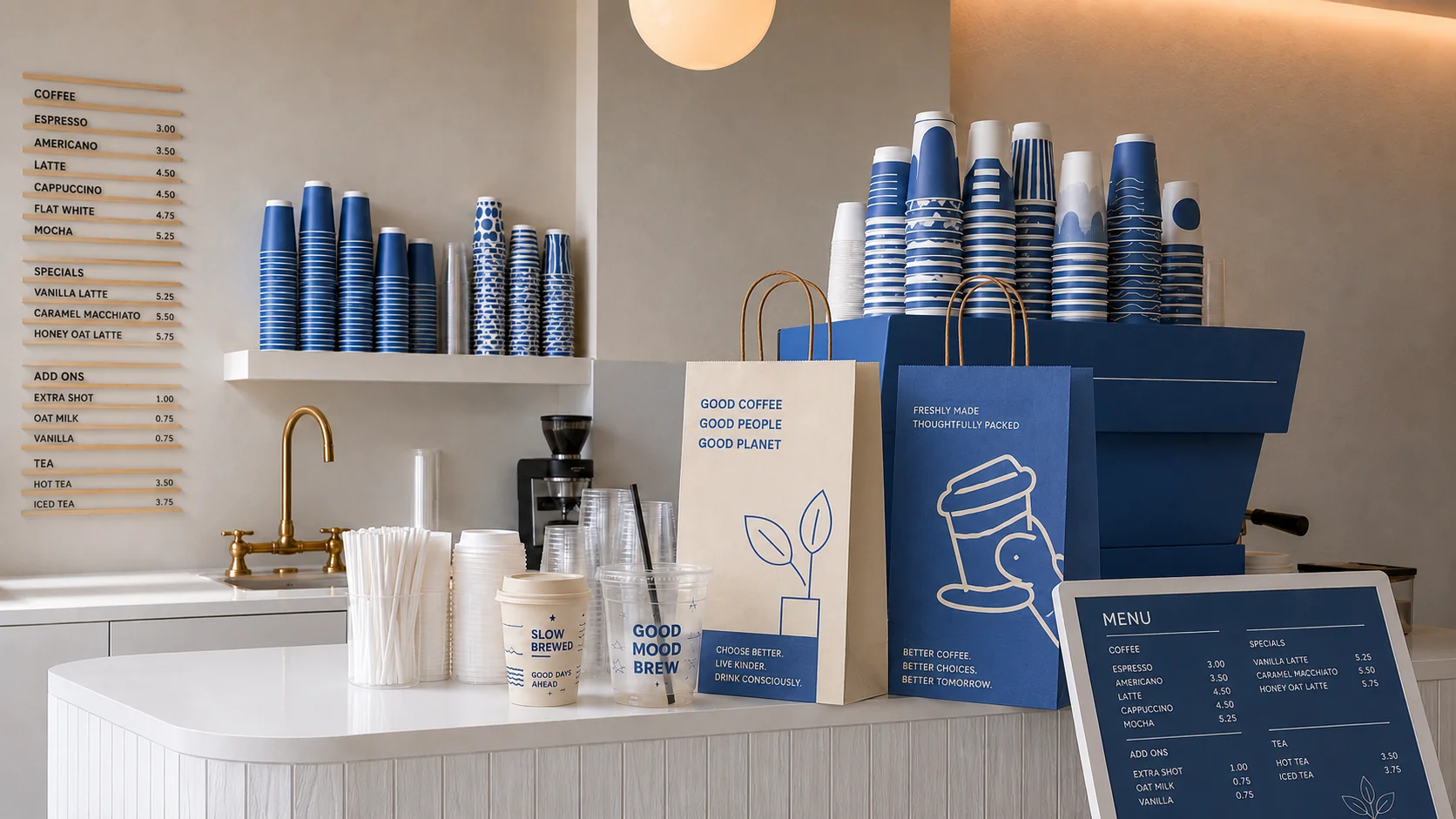
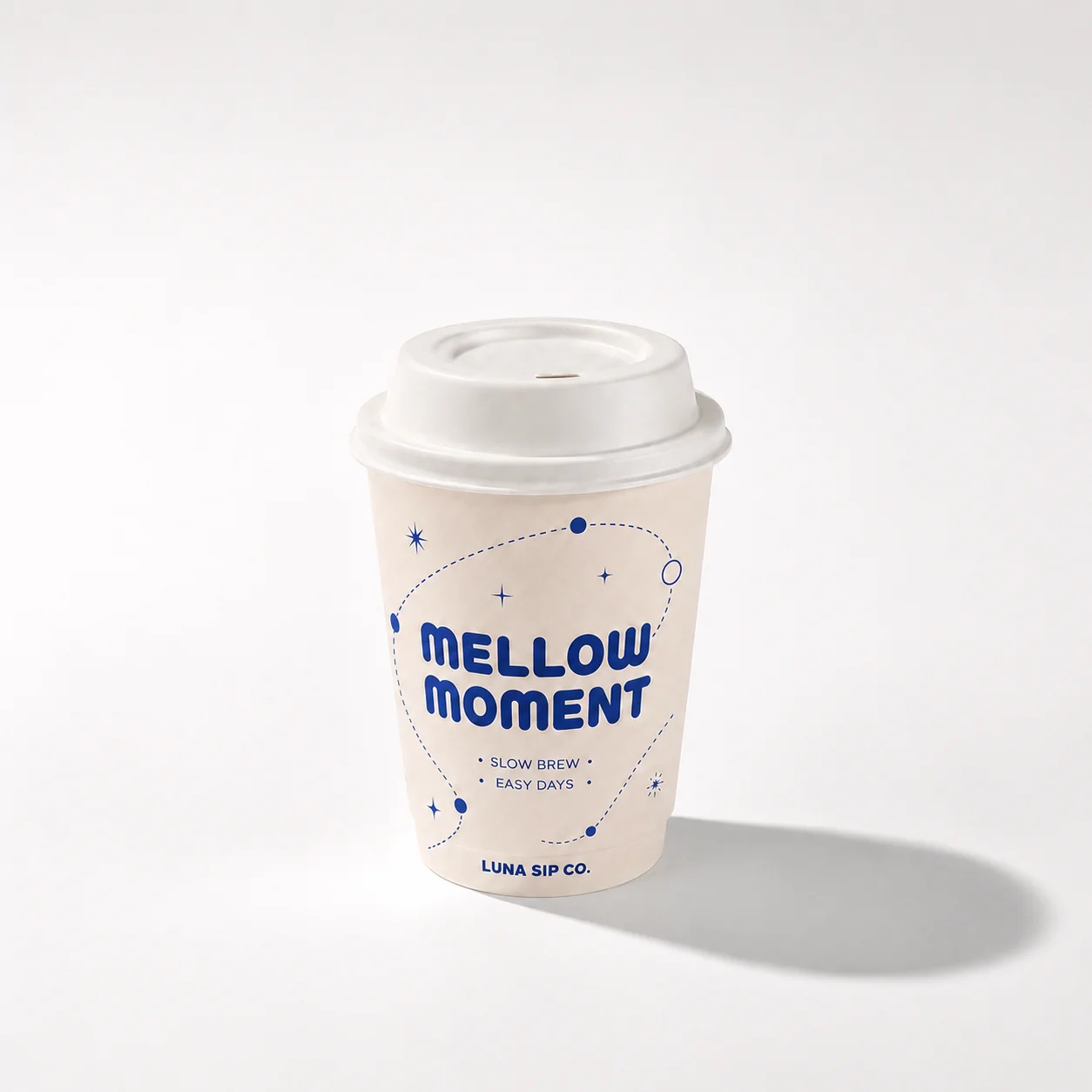
Custom printed paper cups turn a frequently handled item into a visible brand touchpoint. They can reinforce recognition at the counter, in customers’ hands, in offices, and in social content.
Ecoally’s current paper cup listing offers full-color CMYK printing. This supports multicolor logos, patterns, illustrations, and campaign artwork, but a curved cup is not a flat poster. Its tapered shape changes how a design is seen.
Keep the Main Logo Easy to Find
Place the primary brand mark in a prominent area and give it enough clear space. Avoid making the logo so large that important details wrap sharply around the sides.
Account for the Seam and Cup Curvature
Do not place small text, QR codes, contact information, or critical graphic details close to the seam. Ask for the correct dieline and keep essential content inside the recommended safe area.
Design for the Cup’s Real Viewing Distance
Most customers will see the cup at arm’s length or on a table. Thin lines and very small text may disappear even if they look sharp when enlarged on a monitor.
Review Color Expectations
CMYK printing can differ from colors displayed on an RGB screen. If a brand color must be closely controlled, discuss color references and proofing options with the supplier. A digital preview is useful for placement, but it does not always reproduce the exact appearance of ink on the production material.
Create a Flexible System Across Sizes
Artwork may need to be adapted for 8 oz, 12 oz, and 16 oz dielines. A layout that works on a large cup may feel crowded on the smallest size. Build a consistent visual system, then adjust scale and spacing for each format.
Ecoally’s online design flow supports logo upload and 3D previews for selected packaging. Use the preview to evaluate overall placement, then rely on the production proof and samples for final approval.
Always Test Samples Before a Full Order
A sample test is not just a design check. It is a short operational trial.
Use the actual drinks, equipment, and service routines in your cafe. Involve baristas or front-of-house staff because they will notice handling problems that a purchasing team may miss.
| Test area | What to check |
|---|---|
| Recipe fit | Finished volume, headspace, foam and ice clearance |
| Lid fit | Application speed, rim seal, drinking opening, normal transport |
| Heat handling | Customer comfort, sleeve need, expected holding period |
| Cold handling | Condensation, grip, ice volume, lid suitability |
| Equipment | Espresso machine clearance, dispensers, storage racks and carriers |
| Printing | Logo placement, seam position, text readability and color appearance |
| Workflow | Cup separation, stacking, lid separation and rush-hour speed |
| Delivery | Stability inside carriers or bags during a realistic journey |
Document the results for every size instead of approving one cup and assuming the others behave identically.
Plan Order Quantities by Configuration
A low headline minimum does not always mean one minimum can be divided freely across every size and color. Suppliers commonly treat each combination as a separate configuration.
Ecoally’s current listing shows a minimum of 100 cups per size-and-lid-color configuration, with lids included. That means 8 oz with black lids and 12 oz with white lids should be planned as separate variants.
Before ordering, calculate:
- Weekly usage for each cup size
- Sales seasonality
- Storage capacity
- Upcoming promotions or artwork changes
- The risk of menu changes
- Reorder and production lead time
- Expected waste from obsolete branding
For a new concept or artwork refresh, a smaller first run can help validate demand before scaling. Ecoally’s guide to low-MOQ custom packaging explains how smaller batches can support testing and inventory control.
Common Custom Paper Cup Buying Mistakes
Choosing Size by Name Alone
“Small,” “medium,” and “large” are not precise specifications. Use measured capacity and test complete recipes.
Assuming Every Lid Fits Every Cup
Match the exact cup rim and lid specification. Do not substitute lids based only on ounce capacity.
Approving Artwork Only on a Flat Screen
Review the dieline, 3D preview, proof, and—when possible—a physical sample.
Ignoring the Full Service Environment
A cup must work with machines, dispensers, carriers, sleeves, delivery bags, and staff routines.
Ordering Too Many Variants
Extra combinations divide purchasing volume and increase storage complexity. Start with the sizes and lid colors your menu genuinely needs.
Making Environmental or Compliance Claims Without Evidence
Ask for documents that apply to the exact material, lining, inks, and intended market. Avoid turning a product name into a broader claim that has not been verified.
A Practical Ordering Workflow
Use this sequence for a smoother custom paper cup project:
- Map drinks to finished serving volumes.
- Select the fewest cup sizes that support the menu.
- Define hot and cold service requirements.
- Confirm cup construction, material, and barrier specifications.
- Match the correct lid to each cup.
- Request dielines and prepare size-specific artwork.
- Review the 3D preview or digital proof.
- Test physical samples with actual beverages and equipment.
- Confirm quantity by configuration, production timing, and shipping.
- Approve production only after documenting the final specification.
For more cafe packaging options, visit Ecoally’s coffee shop packaging collection.
Ready to Plan Your Branded Cup Program?
Ecoally’s custom paper cups with lids are currently available in 8 oz, 12 oz, and 16 oz sizes, with full-color CMYK printing and black or white matching lids. The listing starts at 100 cups per configuration and supports online design previews on available sizes.
Choose the sizes that fit your menu, upload your artwork, and review the live product options. If your drinks require a different construction, lid type, or technical specification, contact Ecoally before placing the order so the complete serving system can be confirmed.
Frequently Asked Questions
What size custom paper cups should a cafe order?
Choose sizes based on finished recipes rather than category names. Prepare each drink with its normal coffee, milk, foam, ice, and toppings, then confirm capacity and headspace. An 8 oz, 12 oz, and 16 oz range can cover many menus without creating excessive inventory.
Can custom paper cups be used for both hot and cold drinks?
It depends on the cup specification and drink. Ecoally’s current paper-cup listing describes the material as intended for hot and cold beverage service, but buyers should test samples with their actual temperatures, ice levels, holding times, lids, and transport conditions.
Are lids included with Ecoally custom paper cups?
Yes. Ecoally’s current standard listing includes matching sip lids in black or white. Confirm whether that lid style suits your beverage, especially if you need a straw opening, flat cold lid, or domed lid.
What is the minimum order for custom printed paper cups?
Ecoally’s current listing starts at 100 cups per configuration. A configuration consists of the selected cup size and lid color. Live quantity tiers vary by size, so check the product page before ordering.
Can I print a full-color design on paper cups?
Ecoally currently lists full-color CMYK printing. Request the correct dieline, keep important elements away from the seam, and review proofs for placement and readability. Discuss color matching with the supplier if exact brand-color reproduction is important.
Do hot paper cups need sleeves?
That depends on drink temperature, wall construction, expected holding time, and customer experience. Ecoally’s 8 oz cup is currently double-wall, while its 12 oz and 16 oz cups are single-wall. Test samples with your drinks to determine whether a sleeve is appropriate.
Are custom paper cups recyclable?
Recyclability depends on the complete cup construction, inner barrier, food or drink residue, local collection rules, and available processing facilities. Request product-specific documentation and check local guidance before making a recyclability claim.
Should I order samples before production?
Yes. Test each cup-and-lid combination with actual drinks, equipment, carriers, sleeves, and service routines. A digital preview can help evaluate artwork placement, but it cannot replace physical fit and handling tests.