




Greaseproof Paper vs. Parchment Paper: What's the Difference?
A burger wrapper that turns translucent with oil and a cookie that sticks to a baking tray are both paper-performance problems—but they are not the same problem.
Greaseproof paper and parchment paper can both resist oil, but they are usually chosen for different jobs. For wrapping burgers, sandwiches, fries, and pastries or lining trays and baskets, choose a food-contact greaseproof paper made for packaging. For baking and nonstick release, choose parchment paper with a manufacturer-stated oven rating.
The simple rule is: choose by the job, not by the name. Product names and constructions can overlap, so always check the specification for the exact paper you plan to buy.
If your goal is customer-facing wrapping or lining, you can also explore Ecoally custom greaseproof paper.
Greaseproof Paper vs. Parchment Paper at a Glance
| Decision factor | Greaseproof food-wrapping paper | Baking parchment paper |
|---|---|---|
| Primary job | Wrapping, lining, serving, and presentation | Baking, cooking, and food release |
| Grease resistance | Designed to slow oil penetration; performance varies by grade | Usually grease-resistant; performance still varies |
| Nonstick release | Not guaranteed | Usually a key feature of baking grades |
| Oven use | Only if the exact grade carries a suitable time and temperature rating | Often made for oven use, but the stated limit still applies |
| Microwave or air-fryer use | Never assume suitability | Use only when the manufacturer explicitly permits it |
| Custom printing | Often suited to logos and repeating brand patterns | Possible for some grades, but the ink and heat requirements must be verified together |
| Best foodservice uses | Burgers, sandwiches, pastries, fries, tray liners, and takeaway presentation | Cookies, bread, cakes, roasting, and other approved cooking applications |
| Sustainability | Depends on fiber, barrier treatment, ink, food residue, and local disposal options | Depends on the complete product and local disposal options—not the name alone |
What Is Greaseproof Paper?
Greaseproof paper is engineered to slow or prevent fats and oils from soaking through. Depending on the grade, that performance can come from a dense fiber structure, a surface treatment, a coating, or a combination of methods.
Food businesses commonly use it to:
- Wrap burgers, sandwiches, tacos, and pastries
- Line baskets, trays, clamshells, and takeaway boxes
- Separate cookies, cheese, confectionery, or baked goods
- Protect the inside of a bakery box
- Present food on a counter or at an event
- Add a printed logo or pattern to every order
Its packaging advantage is the combination of grease control and presentation. A printed sheet can turn an everyday liner into a visible brand touchpoint without requiring a custom box for every menu item.
However, greaseproof does not automatically mean oven-safe or nonstick. Some greaseproof grades are designed for baking; others are intended only for wrapping and serving. Do not place a wrapping grade in an oven, microwave, or air fryer unless the supplier provides written approval for the intended appliance, temperature, and contact time.
What Is Parchment Paper?
In a commercial kitchen, parchment paper usually refers to a paper designed as a baking or cooking liner. Many retail and foodservice baking parchments use a release treatment, such as silicone, to help food lift cleanly. But not every paper sold as “parchment” has the same construction.
Typical uses include:
- Lining cookie sheets and baking pans
- Handling dough and sticky mixtures
- Separating frozen bakery products
- Cooking food in a folded paper parcel
- Reducing direct food contact with trays during production
- Supporting bake-and-serve applications when the grade is designed for them
The terminology can be confusing. Vegetable parchment, coated baking parchment, and silicone-treated greaseproof paper are not necessarily identical materials, yet suppliers may place them in the same broad “baking paper” category.
For a buyer, the intended-use specification matters more than the label. Confirm that the exact paper is suitable for your food type, process, temperature, and contact time.
Six Key Differences That Matter to Food Businesses
1. Their Main Jobs Are Different
Greaseproof wrapping paper is normally selected for service and packaging after food has been prepared. It needs to fold well, resist visible oil marks for the required holding period, and present the food neatly.
Baking parchment is selected for a production process. It must maintain suitable performance during heating and help baked or cooked food release from a pan or tray.
2. Grease Resistance Does Not Equal Nonstick Release
A sheet can slow down oil without releasing sticky dough, melted cheese, or caramel cleanly. That is why grease resistance alone is not enough for baking.
If release is important, ask for a paper grade with documented nonstick or release performance. If the job is wrapping a finished burger or lining a basket, that extra baking performance may be unnecessary.
3. Heat Suitability Is Product-Specific
There is no universal oven temperature for every parchment paper, and there is no safe assumption that general greaseproof paper can be heated.
A valid heat claim should identify the product, maximum temperature, contact time, and any appliance restrictions. Follow the supplier’s directions and never expose paper to an open flame, heating element, or use that the manufacturer excludes.
Ecoally’s current custom greaseproof wrapping grade is designed for wrapping and lining; Ecoally does not recommend it for oven or microwave use.
4. Moisture and Steam Change Performance
Oil is only one part of the packaging problem. A hot burger with sauce, a chilled pastry, and frozen dough expose paper to very different combinations of moisture, steam, fat, temperature, and time.
A wrapper that works for a dry cookie may soften around a hot, saucy sandwich held inside a closed delivery box. Test the sheet with the messiest menu item and the longest realistic delivery time—not only with a dry sample on a counter.
5. Custom Printing Favors Customer-Facing Wraps
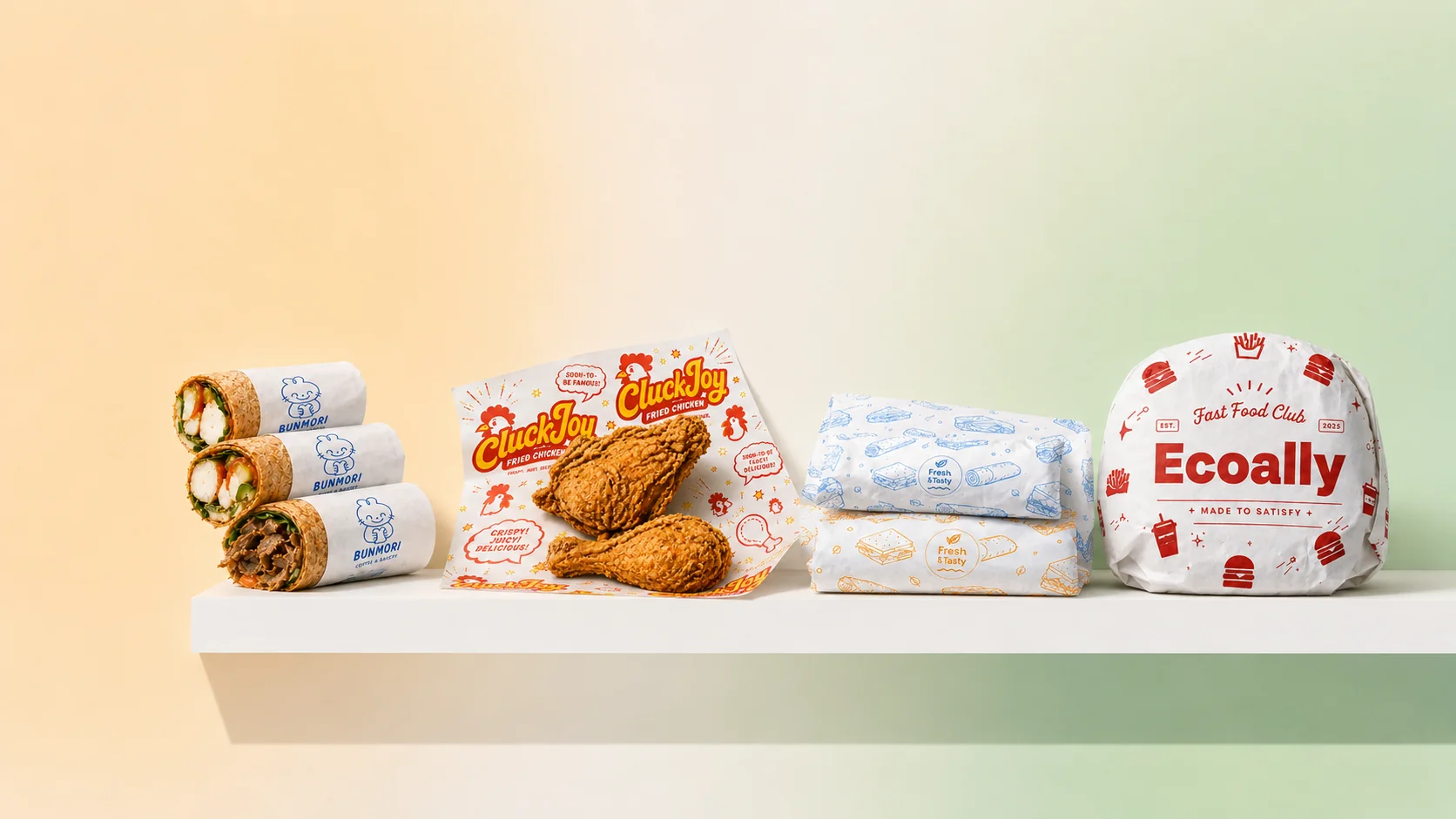
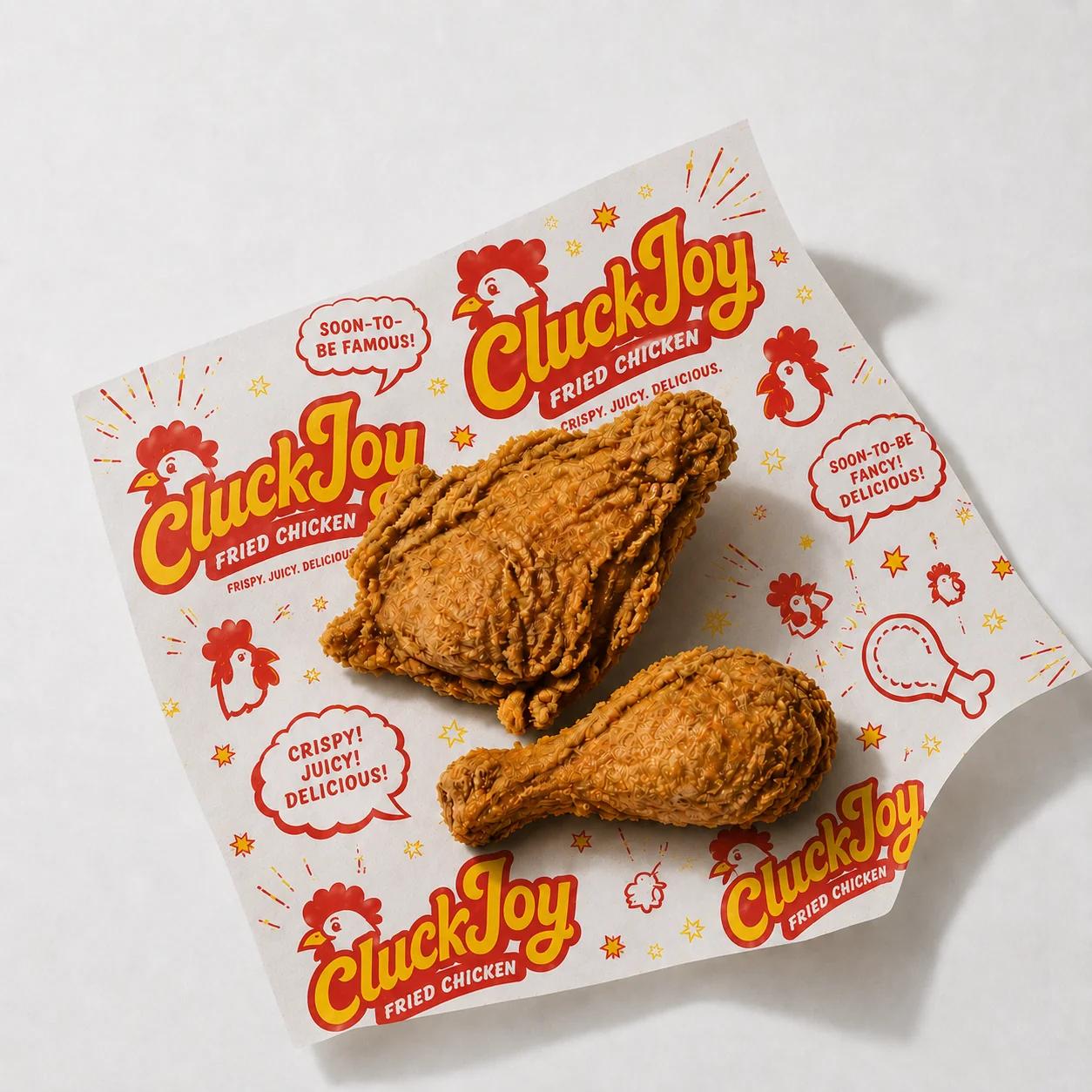
Greaseproof packaging paper is often a practical canvas for repeating logos, colors, or patterns. It can create a consistent brand experience across sandwiches, pastry boxes, baskets, and takeaway trays.
Printed parchment is possible, but any sheet that will be heated requires more than a printable surface. The paper, barrier treatment, ink, print coverage, and intended heating conditions must be evaluated as a complete construction. Standard custom-printed food wrapping paper should not be treated as an oven liner.
6. Disposal Depends on the Finished Product
Neither “paper,” “greaseproof,” nor “parchment” guarantees that a used sheet can be recycled or composted.
Fiber source, coatings, treatments, inks, adhesives, and food contamination can all affect the available disposal route. Local collection rules also vary. Before making an environmental claim, ask what was tested, which standard applies, and whether the required recycling or composting system is available where the paper will be used. For a deeper look at how fiber and barrier choices affect end-of-life options, see our guide to biodegradable and compostable packaging materials.
Which Paper Is Better for Common Food-Business Uses?
Burgers, Sandwiches, Fries, and Deli Items
Choose a food-contact greaseproof wrapping grade.
These foods need paper that folds easily, manages oil during service or delivery, and keeps presentation tidy. Printed sheets also put your logo in the customer’s hands at the most visible moment of the meal.
Test the paper with your highest-fat item, hottest serving condition, and longest expected hold time. For more menu-wide ideas, see Ecoally’s restaurant packaging guide.
Pastries Served After Baking
For croissants, donuts, cookies, or cake slices that have already been baked, greaseproof paper is usually the more practical serving or box-lining material. It can help manage oil marks while creating a branded presentation.
If the pastry enters the oven while touching the paper, use a baking parchment rated for the full process. A small bakery may therefore use both: approved parchment in production and printed greaseproof paper at the point of sale. Explore more packaging ideas for bakeries.
Cookies, Bread, and Dough Baked on a Tray
Choose baking parchment with documented heat and release performance.
Confirm the maximum recommended temperature, permitted duration, oven restrictions, and number of uses if the supplier makes a reuse claim. Do not transfer a temperature limit from one parchment brand or grade to another.
Coffee-Shop Counter Service
A coffee shop may need both papers.
Use greaseproof sheets to wrap breakfast sandwiches, line pastry displays, or place beneath cakes and cookies in takeaway boxes. Use specified baking parchment for items cooked or reheated directly on paper.
Keeping the jobs separate can simplify purchasing: branded greaseproof paper for customer-facing presentation and clearly rated parchment for back-of-house production.
Freezer-to-Oven or Reheating Applications
Do not select these applications by material name alone.
Freezing, thawing, reheating, and baking place different demands on a sheet. The paper may need wet strength, dimensional stability, release performance, and resistance across a defined temperature range. Ask for documentation that covers the complete process.
A general food wrapper should never be treated as a freezer-to-oven liner simply because it resists grease.
Can You Substitute Greaseproof Paper for Parchment Paper?
Not automatically.
You may be able to use a suitable parchment sheet as a post-cook wrapper, although it may be less economical or less convenient for folding and printing. The reverse substitution is riskier: a packaging-grade greaseproof sheet may not provide the heat resistance or release performance needed for baking.
Before substituting either material, check four things:
- Is it intended for direct contact with your type of food?
- Is it approved by the manufacturer for the required temperature and time?
- Does it provide the grease, moisture, and release performance you need?
- Is the complete printed or coated construction suitable for that use?
If any answer is unclear, request the specification and test a sample instead of relying on the product name.
How to Specify Paper Before You Order
Ask potential suppliers these questions:
- What food and use conditions does the documentation cover? Dry, fatty, acidic, moist, hot, chilled, and frozen foods are not identical applications. In the United States, the FDA distinguishes both food types and conditions of use.
- What is the paper’s basis weight and grease-barrier performance? Compare measurable specifications rather than relying only on “premium” or “heavy duty.”
- Does it have the required wet strength? This matters when condensation, sauce, or steam is present.
- Is there a written time-and-temperature rating? Ask whether it applies to your oven or appliance type.
- Which coatings, treatments, and inks are used? Confirm that the complete construction is suitable for the intended food-contact setup.
- Which disposal claims are supported? Request the test standard, certification scope, and disposal conditions for the finished printed product.
- Can you test samples before a full order? Real food and real operating conditions reveal problems a data sheet may not show.
For U.S. buyers, avoid treating broad phrases such as “food grade” or “FDA certified” as a substitute for documentation. The FDA regulates food-contact materials based on their components and intended uses. Ask the supplier for the records that apply to the exact paper you are purchasing.
A Simple Five-Step Sample Test
Before placing a production order, test the paper in your normal workflow:
- Grease holdout: Place your fattiest hot product on the paper for the full service or delivery time. Check for staining and transfer to the surface below.
- Moisture and steam: Close the item in its normal box or bag. Inspect whether the sheet softens, tears, or sticks.
- Wrap performance: Fold the paper around the product at service speed. Make sure it stays closed without cracking.
- Print durability: Rub the printed surface when dry and after realistic warmth and moisture exposure. Report any smudging or color transfer.
- Workflow fit: Confirm sheet size, storage space, dispenser compatibility, packing speed, and paper use per order.
For parchment, add a controlled baking test using the intended food, appliance, temperature, and time—always within the supplier’s stated limits.
The Bottom Line
Choose greaseproof paper when the main job is to wrap, line, serve, protect, or brand prepared food.
Choose parchment paper when the main job is baking, cooking, or reliable food release under a documented heat condition.
Some specialty papers can perform both roles, but that capability must come from the exact specification—not from the words “greaseproof” or “parchment” alone.
For customer-facing sandwich wraps, pastry liners, takeaway boxes, plates, and baskets, review the current sizes and print options for Ecoally custom greaseproof paper. Upload your artwork, use the online 3D preview, or ask the design team for basic layout assistance before approving your order.
Frequently Asked Questions
Is greaseproof paper the same as parchment paper?
No. The categories can overlap, but the names do not guarantee the same construction or performance. Greaseproof wrapping paper is commonly selected for packaging and serving; baking parchment is selected for heat exposure and food release. Compare the exact specifications.
Can greaseproof paper go in the oven?
Only when the manufacturer states that the exact grade is suitable for the intended oven, temperature, and duration. General greaseproof wrapping paper should not be assumed oven-safe.
Which is better for baking?
Parchment paper made and rated for baking is usually the right choice. Grease resistance alone does not provide the heat stability or nonstick release that a baking process may require.
Which is better for burgers, fries, and sandwiches?
A food-contact greaseproof wrapping grade is usually the more practical option. It is designed for folding, lining, serving, and customer-facing presentation. Test the paper with your actual food and holding time.
Is greaseproof paper the same as wax paper?
No. Wax paper has a waxed surface and should not be treated as baking parchment. Do not place it in an oven unless the manufacturer explicitly approves that exact use.
Does grease resistance mean nonstick?
No. Grease resistance measures how a sheet handles oil; nonstick or release performance describes how cleanly food lifts from it. A paper can provide one without the other.
Is parchment paper microwave-safe?
Some parchment products are labeled for microwave use, but the permission is product-specific. Follow the paper manufacturer’s directions as well as the appliance instructions.
Are greaseproof paper and parchment paper recyclable or compostable?
It depends on the exact fiber, coatings, treatments, ink, food residue, and local collection system. Check verified claims for the finished product and confirm what your local facility accepts.