Custom Food Labels for Small Food Brands: Requirements, Sizes, Materials & Costs
Custom food labels do two jobs at once: they carry the brand, and they carry the legal minimum every packaged food in the US has to show. For a small brand selling jam, granola, hot sauce, cookies, or coffee, the compliance half is shorter than it looks — five required elements, plus a Nutrition Facts panel that many small producers are allowed to skip — and the printing half is cheap: custom labels run from roughly $0.04 to $1.00 each depending on size, material, and quantity.
This guide covers what must be on a food label under federal rules, when the Nutrition Facts panel is required and when it is not, how state cottage food rules layer on top for home-kitchen producers, which label materials survive fridges and grease, which sizes fit jars and bags, and what custom printing costs in 2026. It is a practical summary, not legal advice; the FDA's Food Labeling Guide and your state's cottage food page are the final word.
What Must Be on a Food Label: The Five Required Elements
Every packaged food sold in the US needs these five items, whether it is made in a plant or a home kitchen:
| Element | What it means | Where it usually goes |
|---|---|---|
| Statement of identity | The common name of the food ("Strawberry Jam," "Granola") | Front panel, prominent |
| Net quantity of contents | Weight or volume, in US and metric units ("8 oz (227 g)") | Bottom third of the front panel |
| Ingredient list | Every ingredient in descending order by weight, with sub-ingredients in parentheses | Information panel (side or back) |
| Allergen declaration | Any of the nine major allergens: milk, eggs, fish, shellfish, tree nuts, peanuts, wheat, soybeans, sesame | "Contains:" line under the ingredients, or called out in the list |
| Name and place of business | Manufacturer, packer, or distributor name plus city, state, and ZIP (street address if not listed locally) | Information panel |
Two formatting rules trip up small labels most often: the mandatory text generally has to be at least 1/16 inch tall, and the identity and net quantity belong on the same panel a shopper sees first. Both push toward a label big enough to read, which is the real reason a 1-inch circle cannot be your only label on a jar.
Do You Need a Nutrition Facts Panel?
Often not, if you are small. Federal rules provide small-business exemptions from nutrition labeling; the widely used tier applies to firms with fewer than 100 full-time employees selling fewer than 100,000 units of a product per year, and it requires filing a short notice with the FDA. Very small operations may fall under a lower tier that needs no filing. The exemption disappears the moment the label makes a nutrient or health claim ("low sugar," "high protein," "healthy"), so if you want the exemption, keep marketing language off the panel.
Beyond the exemption, several categories do not require a Nutrition Facts panel at all, which answers the question small producers search for most:
- Raw fruits, vegetables, and fish sold as-is.
- Foods prepared and sold for immediate consumption — a bakery counter, a deli, a café — as long as they are not packaged for retail shelves.
- Foods with no meaningful nutrients, such as plain coffee, tea, and most spices.
- Very small packages (under 12 square inches of total surface) if the label gives an address or phone number for nutrition information.
- Products covered by a small-business exemption as described above.
If you do need the panel, the format is standardized down to the line spacing, so generate it with a labeling tool or a food lab rather than typing it by hand. Details for every case are in the FDA's Food Labeling Guide and its small business exemption page.
Cottage Food Labels: The State Layer
If you sell from a home kitchen under a cottage food law, your state adds its own required lines on top of the federal five. The exact wording is set state by state, but the pattern is consistent:
- A disclosure statement that the product was made in a home kitchen not inspected by the state or local health department (the sentence is prescribed; copy it exactly from your state's page).
- Product name, ingredients, and allergens, as above.
- Your name and address, and in some states a registration or permit number.
- Net weight, and in some states a production date.
Because the required statement can run to 20 words, cottage food labels are the case where a second, larger information label on the back or bottom beats trying to fit everything on the front. State agriculture and health departments publish the wording and often a free template; search your state's name plus "cottage food labeling."
Label Materials: Which One Survives Your Product
The label has to survive the product's life, not just the shelf:
| Material | Handles | Weak against | Typical uses |
|---|---|---|---|
| Uncoated or recycled paper | Dry, ambient storage | Moisture, oil, condensation | Bakery boxes, paper bags, granola, coffee, dry goods, pantry jars |
| Coated or laminated paper | Light handling, brief moisture | Freezer, oily surfaces | Jars and boxes that stay dry |
| BOPP film / vinyl | Fridge, freezer, condensation, oil | Recyclability of the label itself | Sauces, refrigerated and frozen products, bottles |
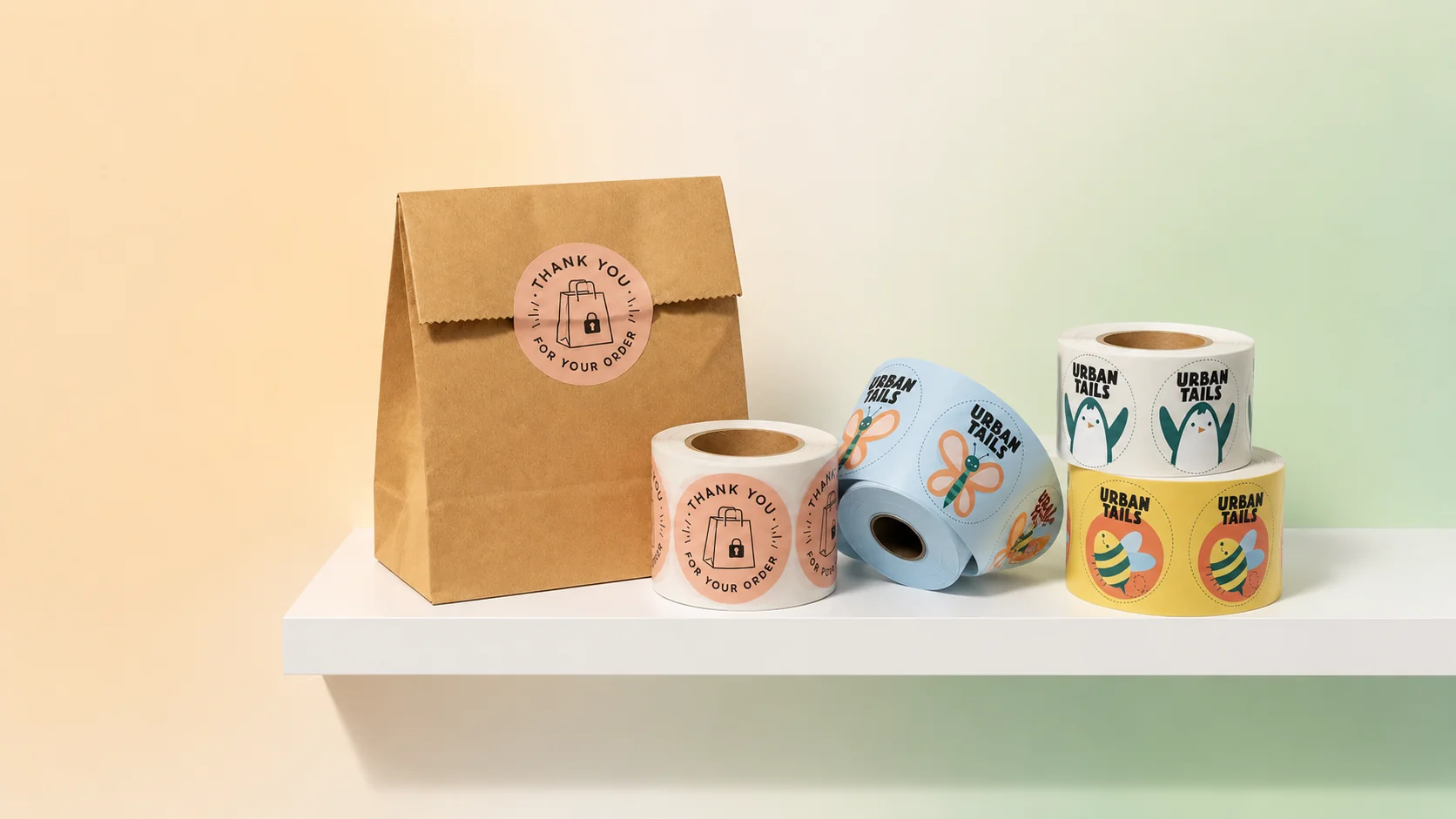
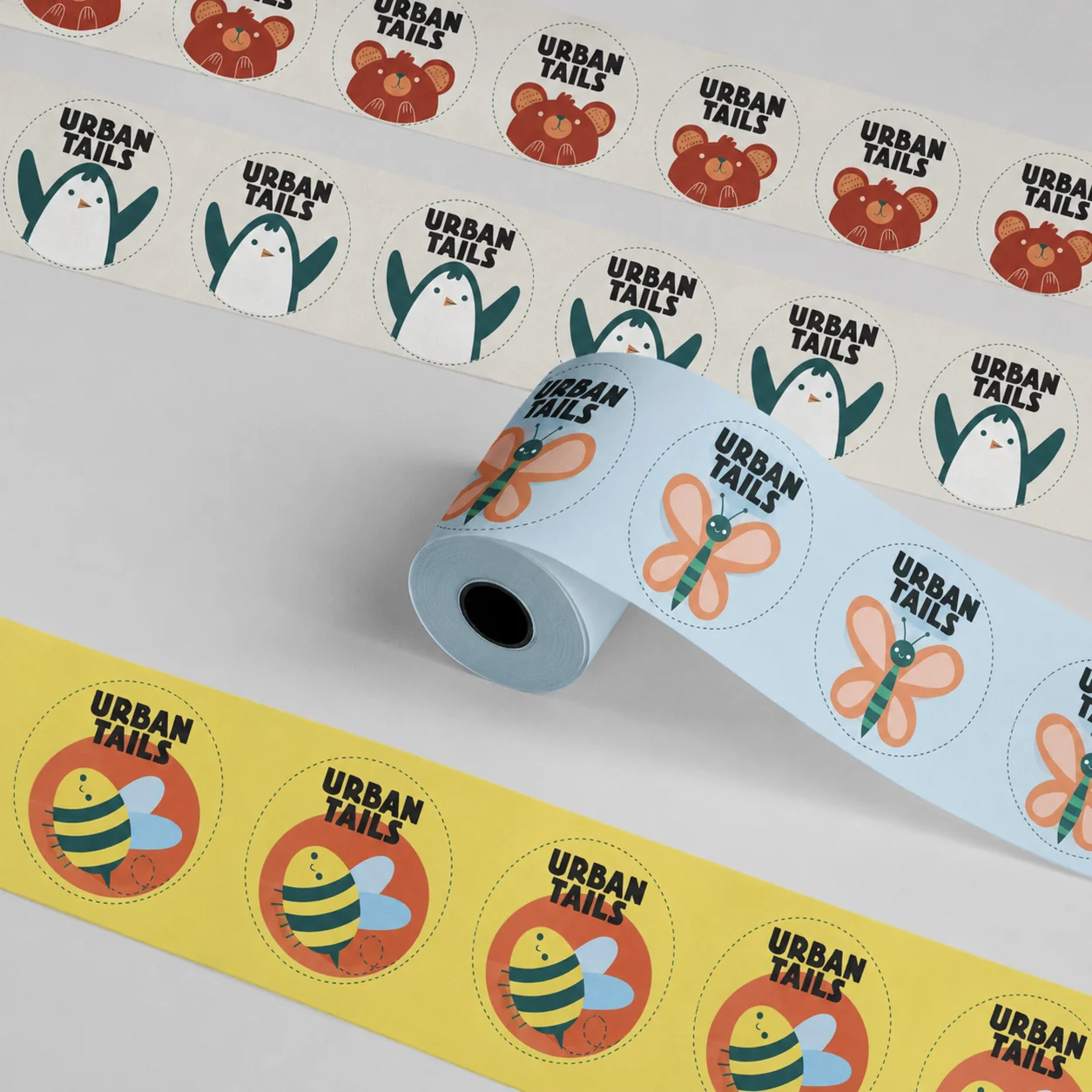
Match the label to the worst moment in the product's life. A hot sauce bottle sweats in the fridge, so it wants film; a granola bag or a bakery box lives dry, so paper does the job and keeps the package in one material family. Ecoally's custom recycled sticker sheets are printed on 100% recycled white paper in matte or glossy, which suits dry-goods packaging, bakery boxes, and paper bags; for freezer and wet-bottle products, specify a film label from a supplier who offers it.
Sizes and Shapes for Jars, Bags, and Boxes
Sizing is about fitting the required text at legible size, then leaving room for the brand:
| Size | Shape | Fits |
|---|---|---|
| 1 × 1 in, 1.5 × 1.5 in | Circle or square | Seals, lid dots, cookie and pastry bags |
| 1 × 2 in, 1 × 3 in, 1.5 × 2.5 in | Rectangle | Ingredient strips, price and date tags, lid bands |
| 2 × 2 in | Circle or square | Jar lids, small bags, front logo on boxes |
| 2 × 3.2 in, 2 × 4 in | Rectangle | Jar fronts, bag fronts with name and net weight |
| 3 × 3 in | Circle or square | Box fronts, large jar lids |
| 3 × 5 in, 3 × 6 in | Rectangle | Full ingredient and allergen panels, bakery box tops |
| 4 × 4 in | Square | Large jars, boxes, wide-mouth containers |
A common two-label setup for jars: a 2 × 3.2 or 2 × 4 in front label with the name, brand, and net weight, plus a 3 × 5 in back label carrying ingredients, allergens, business address, and any cottage food statement. For bags, one 3 × 5 in label on the face often holds everything. Ecoally's sheets come in all twelve sizes above, from 250 labels.
What Custom Food Labels Cost in 2026
Surveying published US prices in September 2026:
| Route | Typical price per label | Notes |
|---|---|---|
| Online sheet labels, small runs | $0.10–$1.00 at 100–500 labels | Cheapest way to get a brand on a jar this week |
| Online roll labels | $0.04–$0.25 at 1,000–5,000 | For anyone labeling by hand at volume or with a dispenser |
| Blank sheets, home printed | A few cents each plus ink | Fine for market tables; fades and smears on anything wet |
As a live example of sheet pricing, Ecoally's recycled sticker sheets start at 250 labels for about $0.37–$0.92 each depending on size, and step down to roughly $0.04–$0.18 at 10,000, with tier tables on the product page. For sealing bags and boxes rather than labeling products, the tamper-proof sticker rolls are the matching item, covered in our tamper-evident labels guide.
The per-product math is what settles it: a $0.30 label on a $9 jar is 3% of price and the first thing a customer reads; at 2,000 jars a year, the difference between a home-printed label and a printed one is a few hundred dollars and a brand that looks retail-ready. The staged-ordering logic for every packaging item — start at the smallest tier, scale once the design stops changing — is covered in low-MOQ custom packaging.
Design Rules That Keep a Food Label Legal and Legible
- Hierarchy: product name first, brand second. Shoppers and inspectors both look for the identity statement; the logo can be smaller than the words "Apple Butter."
- Contrast on kraft. Dark text on kraft paper reads; light text does not. If the packaging is brown, print the label on white stock.
- Bold the allergens. A "Contains: milk, wheat" line in bold under the ingredients satisfies the rule and reads at a glance.
- Leave a writable box. A blank for batch date or best-by lets one printed label cover a year of production.
- Skip claims you cannot back. "Healthy," "low sodium," or "high fiber" are regulated terms that also cancel the small-business nutrition exemption. Describe the food; do not grade it.
- Add a QR code only if it goes somewhere useful. A recipe page or reorder link earns the space; a homepage does not.
For bakery and café brands, the label usually pairs with the bag or box it sits on; sizing labels to those items is covered in the bakery packaging guide, and the case for a printed label on plain paper as a low-volume branding route is made in the deli paper guide.
Frequently Asked Questions
What are the five mandatory requirements for food labels?
Statement of identity (the food's common name), net quantity of contents, the ingredient list in descending order by weight, an allergen declaration covering the nine major allergens, and the name and place of business of the manufacturer, packer, or distributor. A Nutrition Facts panel is a sixth requirement unless the product or business is exempt.
Does a small food business need a Nutrition Facts label?
Not always. Federal small-business exemptions cover low-volume producers — commonly firms under 100 employees selling under 100,000 units of a product a year, with a notice filed to the FDA — as long as the label makes no nutrient or health claims. Foods prepared for immediate consumption and several other categories are exempt outright. Check the FDA's small business exemption page for the current thresholds.
Which foods do not require a nutrition label?
Raw produce and fish, foods prepared and served on the premises (bakery and deli counters, restaurants), foods with no significant nutrients such as coffee, tea, and most spices, very small packages that give an address or phone for nutrition information, and products under a small-business exemption. The five basic label elements still apply to any packaged product.
Where can I get custom food labels printed?
Online label printers ship sheet and roll labels in small runs: sheet labels for a few hundred pieces, rolls from about 1,000. Choose paper for dry goods and film for refrigerated or oily products, and order a proof before a full run. Ecoally's recycled sticker sheets start at 250 labels.
Can I design my own food label?
Yes. Most printers accept your own artwork or provide an online editor; state cottage food pages often provide free label templates with the required wording. Keep mandatory text at least 1/16 inch tall and put the product name and net weight on the same panel.
What size label fits a jar?
For standard 8–16 oz jars, a 2 × 3.2 or 2 × 4 in front label plus a 3 × 5 in back label covers branding and all required information. Small 4 oz jars often use a 2 × 2 in front dot and a 2 × 4 in wrap-around back label.
Are paper labels safe for food packaging?
Labels on the outside of packaging are not in direct food contact, so the concern is durability rather than food safety: paper labels suit dry and ambient products, while refrigerated, frozen, and oily products need film labels with permanent adhesive. Ask the supplier about the adhesive if the label will touch the food surface itself.
Put a Compliant Label on the Next Batch
The rules are short once they are in a table, and the printing costs less than the lid. Draft the five required elements, decide whether you need a Nutrition Facts panel, add your state's cottage food line if it applies, then pick the size and material that survive your product. Upload the artwork to Ecoally's custom recycled sticker sheets page, preview it, and order 250 to see the label on a real jar before scaling.