Custom Paper Bags with Logo: Kraft vs White, Handles, Sizes, Printing, and 2026 Costs
Custom paper bags with a logo are the one piece of packaging that keeps advertising after the sale: the bag rides the sidewalk, the subway, and the office kitchen, and a good one gets reused for a week. They are also one of the cheapest branded items a small business can buy. A printed kraft shopper costs about a dollar to a dollar and a half at a few hundred pieces, a takeout bag with a one-color logo lands under 25 cents at a few thousand, and a boutique tote with ribbon handles can be ordered from 50 pieces.
This guide covers what the search listings leave out: which of the four bag formats fits which business, how brown kraft and white paper change what a logo looks like, what the handle choice says about the brand, the standard US sizes by use, how logos actually get printed, what "no minimum" really costs, and what custom paper bags with a logo cost in 2026 at every quantity from 50 to 50,000.
The Four Custom Paper Bag Formats
Nearly every custom paper bag sold in the US falls into one of four formats, and the format decides the minimum order, the price, and how the logo is printed:
| Format | Handles | Typical use | Minimum and price range (2026) | Ecoally version |
|---|---|---|---|---|
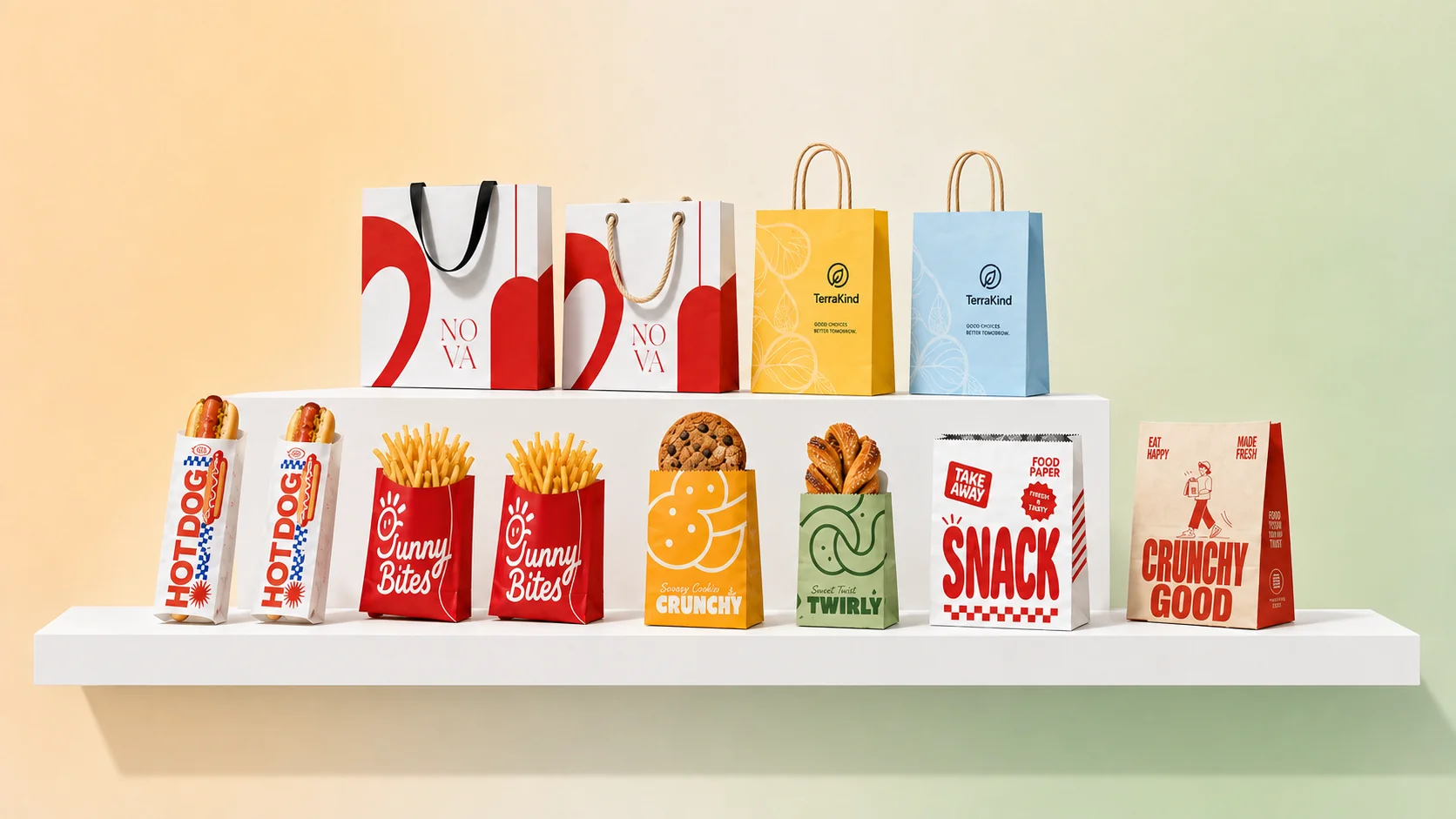
| Twisted-handle kraft shopper | Twisted paper handles glued inside | Retail, bakeries, gift shops, takeout with a handle | 250–1,000 pieces; about $0.90–$1.90 each | Custom paper shopping bags and custom recycled paper bags, five sizes, from 250 |
| SOS takeout bag | None; flat bottom stands on its own | Delis, cafes, grocery, delivery orders | 500–5,000 pieces; about $0.10–$0.60 each for the common sizes | Custom SOS paper bags, nine sizes, from 500 |
| Euro tote and ribbon-handle bag | Flat folded paper, cotton rope, or ribbon handles on heavy board | Boutiques, jewelry, cosmetics, events, corporate gifts | 50–500 pieces; about $1.10–$5.00 each | Custom euro tote bags and ribbon handle bags, six sizes, from 50 |
| Flat merchandise bag | None; a flat envelope-style bag | Cards, apparel basics, small accessories, bakery items | Sold by the thousand; the lowest unit price of the four | Covered by custom bakery bags for food use |
Most businesses need one of the first three. A cafe wants an SOS bag for orders and perhaps a twisted-handle shopper for merchandise; a boutique wants a euro tote; a gift shop or bakery wants the kraft shopper. The food-service side of the choice, with grease and weight limits, is covered in our paper bag food packaging guide; the premium end is covered in the luxury paper bags guide.
Kraft vs White Paper: What Changes the Print
Brown kraft and white paper cost the same at most printers, including Ecoally's, so the choice is about the logo, not the budget.
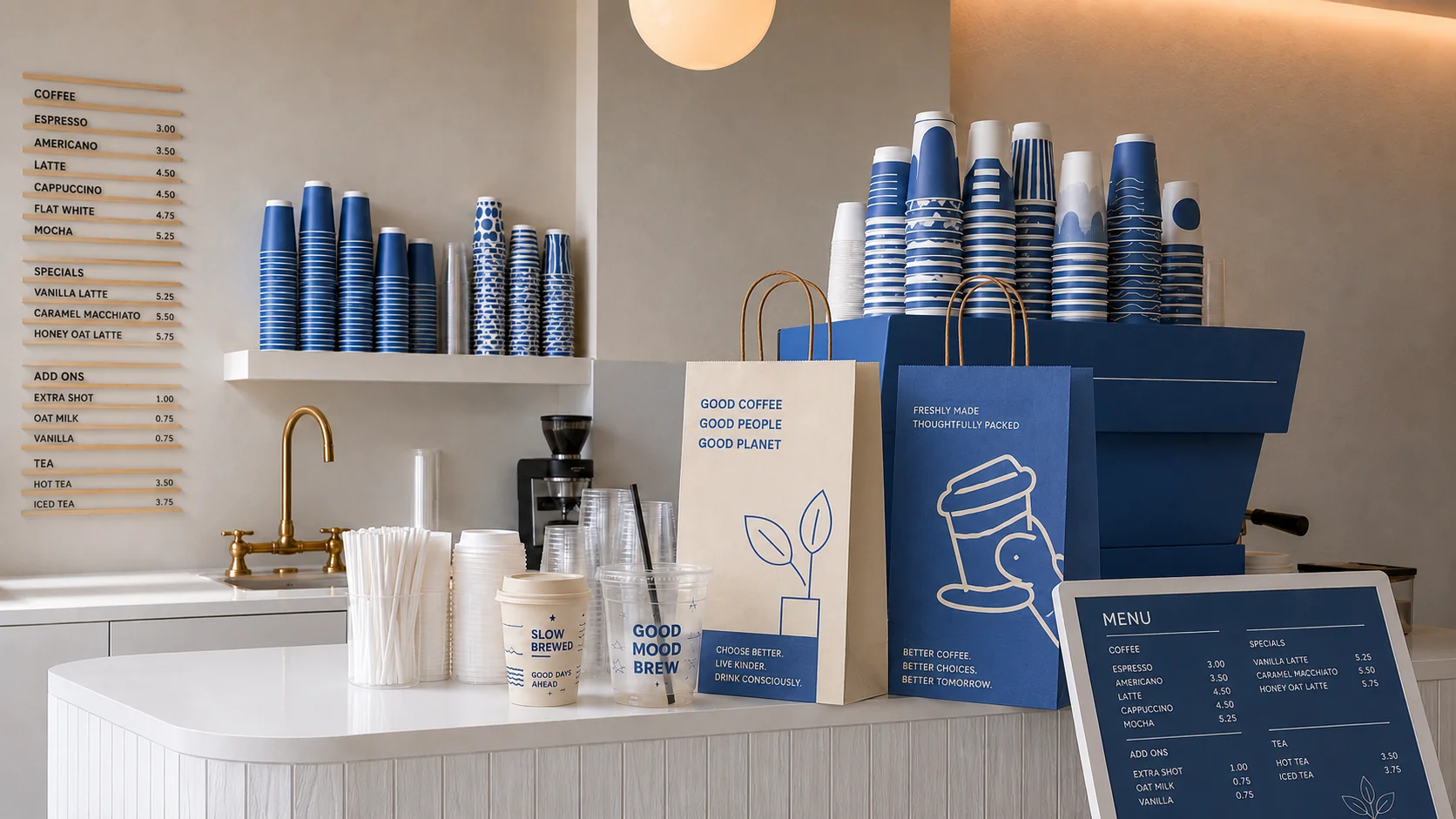
Brown kraft reads natural, hides scuffs and light grease marks, and makes a single dark ink look intentional. Its weakness is color: kraft is a tinted surface, so light and bright inks lose saturation. A yellow logo on kraft turns olive; a pastel disappears. The fix is a dark one-color print (black, navy, forest green, burgundy) or a white ink hit for a reversed-out look. Kraft is the default for bakeries, coffee shops, grocers, and any brand built on an "unbleached" story.
White paper shows ink as designed. Full-color artwork, photographic patterns, and brand colors that must match a Pantone reference all want white stock. It shows marks more readily, so it suits retail and gifting more than greasy takeout. White is the default for boutiques, beauty, and any brand with a bright palette.
A practical test before ordering: print the logo on a sheet of brown wrapping paper and a sheet of white and look at both from across the room. Whichever reads faster is the stock to order.
Handles: Twisted, Flat, Ribbon, or None
Handles set the price tier and the message:
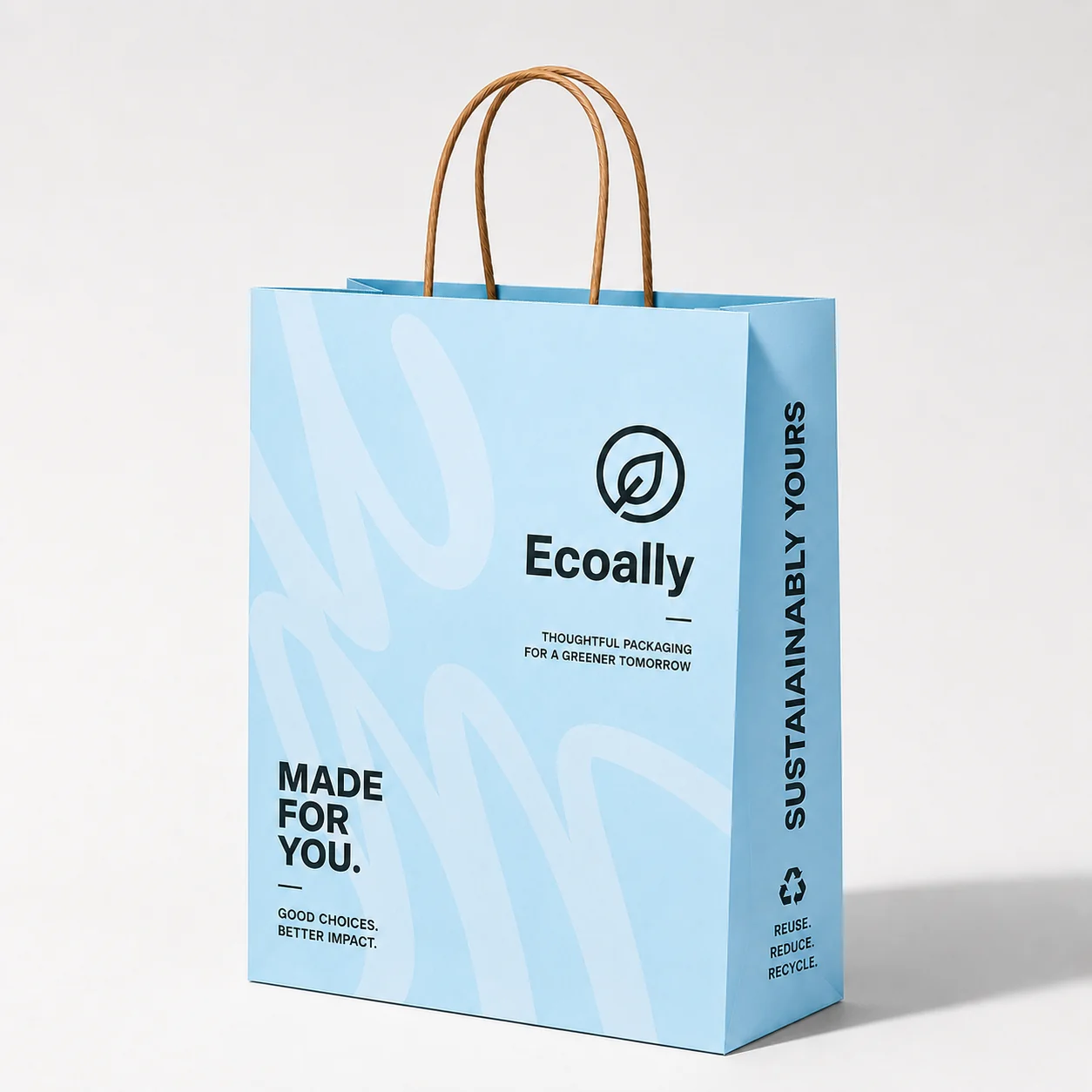
- Twisted paper handles are the standard on kraft shoppers. They are glued to a reinforcing patch inside the bag, rated for several pounds of groceries or pastry boxes, and recyclable with the bag. The right choice for retail and food at the lowest handled price.
- Flat folded paper handles sit on euro totes and read more upscale than twisted handles at a small premium. They fold flat for storage and are easier to grip with a full bag.
- Ribbon and cotton rope handles are threaded through eyelets on heavy paperboard totes. They cost the most and signal a gift: jewelry, cosmetics, apparel, event bags. Ecoally's luxury totes come in ten paper colors and edge styles with ribbon handles or flat euro-tote handles, from 50 bags.
- No handle is the SOS bag: a flat-bottom sack that stands open on the counter for loading and stacks flat in storage. It is the lowest cost per bag, the fastest to fill, and the format every takeout counter runs.
If customers carry a single light item, skip handles and save the money; if they carry food boxes or multiple items, twisted handles are the minimum; if the bag is part of a purchase over about $50, the flat or ribbon handle is worth the difference.
Standard Sizes by Use
US paper shopping bags follow a set of traditional names that printers still use, and they help when comparing quotes. Dimensions below are width × gusset (depth) × height; product pages often list the height first, so compare all three numbers rather than the order.
| Size name | Dimensions | Fits |
|---|---|---|
| Rose | 5.5 × 3.25 × 8.4 in | Jewelry, candles, cards, a single pastry box |
| Cub | 8 × 5 × 10.25 in | Lunch orders, cosmetics, books, small gifts |
| Vanity | 10 × 5 × 13 in | Apparel, shoe boxes, medium gift boxes |
| Grocery style | 10 × 7 × 12 in | Grocery, bakery boxes, wine and food combos |
| Tote | 16 × 6 × 12 in | Wide boxes, pizza-style boxes, multiple garments |
Ecoally's twisted-handle shoppers come in all five, in kraft or white, with one-color or full-color print from 250 bags. SOS takeout bags use a different scale, the "pound" sizes inherited from grocery sacks: Ecoally's nine sizes run from 3.5 × 2.4 × 5.9 in for a single pastry to 11 × 5.9 × 11 in for a full dinner order, and the mid-size 4.7 × 2.8 × 8.5 in bag is the all-purpose cafe and deli size. Luxury totes run from 11 × 4 × 8 in for jewelry and beauty to 19.5 × 5.5 × 14 in for apparel.
Choosing a size: measure the item or box that goes in most often, add an inch of width and an inch of height for clearance, and let the gusset match the box depth. Two sizes cover most shops, a small bag for single items and a mid-size for everything else; a third, larger size only earns its place if customers regularly buy several items.
How Logos Get Printed on Paper Bags
Four methods cover the market, and the one a printer uses explains their minimums and prices:
- One-color spot print (flexographic). A single ink, usually applied from a plate during bag production. The cheapest way to put a logo on thousands of bags, with fine lines and small text limited by the plate. This is what "logo print" means on most SOS and kraft bag listings, and it is why those minimums start at 500 or 1,000.
- Full-color digital (CMYK). Artwork printed directly, no plates, so small runs cost little more than one-color. Patterns, gradients, and multi-color logos are possible, and minimums drop to 250 or lower. Ecoally's twisted-handle shoppers add two to ten cents per bag for full color over one color at the same quantity.
- Full-bleed or all-panel print. Ink across the whole bag, including gussets and bottom. On SOS bags it is a volume product; Ecoally prices full-bleed SOS bags from 20,000 pieces. On luxury totes it appears as "all-panel print" above a few thousand bags, with front-and-back print available from 50.
- Hot foil, embossing, and spot UV. Finishing steps on heavy-board luxury totes: a foil-stamped logo, a raised emboss, or a gloss highlight. They add setup cost and lead time and belong on bags that carry purchases worth many times the bag's price.
Two rules that save a reprint: supply vector artwork (a PDF or SVG, not a screenshot), and ask for a digital proof showing the logo at actual size on the bag's face panel. A logo that fills 60–70% of the panel width reads from across a street; one at 30% looks like a stamp.
How to Print Your Own Paper Bags
For a market stall or a first month of trading, printing bags yourself is reasonable, and three methods work on plain kraft bags:
- Rubber stamp and ink pad. A custom stamp costs $20–$40, and water-based or pigment ink dries fast on uncoated kraft. Expect slight variation from bag to bag, which suits craft and bakery brands.
- Stickers and labels. A printed sticker sheet applied to a plain bag gives a crisp full-color logo with no setup; a 2 × 2 in or 3 × 3 in label on the face panel is the usual size. Sizing and placement rules are in our custom food labels guide.
- Home inkjet on flat bags. Flat merchandise bags and small SOS bags can run through many inkjet printers one at a time if the bag is flattened and fed carefully; handled bags cannot.
The crossover point is volume. Stamping or labeling 100 bags a week is an hour of work; at 300 or more, a printed run at a few cents more per bag pays for itself in labor within the first month, and the result looks like a brand rather than a hobby.
What Custom Paper Bags with Logo Cost in 2026
Surveying published US prices in October 2026, after stripping the "90% off" banners that shopping listings use as bait:
| Bag | Typical price per bag | Where the price lands |
|---|---|---|
| Twisted-handle kraft shopper, printed | $0.50–$1.60 | $1.20–$1.60 at 250 from online printers; $0.50–$0.90 at 1,000–5,000 from promotional suppliers |
| SOS takeout bag, one-color logo | $0.10–$0.60 | Under $0.20 at 5,000 and up; $0.50–$0.60 at a 500-piece first run |
| Euro tote or ribbon-handle bag | $1.10–$5.00 | The low end at 1,000 pieces with front-and-back print; the high end for 50-piece runs and large sizes |
| "No minimum" design-your-own sites | $1.60–$4.00 | 25 to 100 bags at a time; convenient for a launch, expensive past the first order |
As a live example, Ecoally's twisted-handle shopping bags in the Cub size (8 × 5 × 10.25 in) with one-color print cost about $1.38 per bag at 250, $1.20 at 500, $1.15 at 1,000, and $1.11 at 2,000, with full color at $1.45 down to $1.20 over the same tiers; the small Rose size runs $1.15 at 250 to $0.90 at 2,000, and the Tote size $1.84 at 250 to $1.47 at 2,000. Kraft and white are the same price. SOS takeout bags with a logo print start at 500: the all-purpose 4.7 × 2.8 × 8.5 in bag is about $0.56 at 500, $0.33 at 1,000, $0.23 at 2,000, $0.16 at 5,000, and $0.14 at 10,000, and the smallest pastry size reaches $0.10 at 10,000. Luxury totes with ribbon or rope handles start at 50 pieces: the 11 × 4 × 8 in size is about $3.07 at 50, $2.11 at 100, $1.57 at 300, $1.43 at 500, and $1.16 at 1,000.
The per-sale math is the useful lens. A $1.15 printed shopper on a $40 bakery or gift order is under 3% of the ticket; a $0.16 printed SOS bag on a $12 lunch order is just over 1%, replacing a plain bag that already cost $0.05–$0.08. Order a plain sample of the exact size first, then start at the smallest printed tier, following the staging logic in low-MOQ custom packaging.
Minimums: What "No Minimum" Really Costs
Minimum order quantities track the printing method. One-color flexographic printing needs a plate and a production run, so SOS and kraft shoppers printed that way start at 500 to 1,000. Digital printing removes the plate, which is how twisted-handle shoppers reach 250 and heavy-board totes reach 50. "No minimum" sites print one bag at a time on demand, which is why their unit prices sit at two to four times the 250-piece price and why their size and stock choices are narrow.
The practical ladder for a new business: a labeled plain bag for the first weeks, a 50-piece luxury tote or 250-piece printed shopper once the logo is final, and a 500-piece SOS run when daily orders justify it. Each step roughly halves the unit price, and none of them requires a warehouse.
Where to Buy Custom Paper Bags
Four kinds of sellers show up for the same search, and they suit different buyers:
- Online packaging printers (including Ecoally): upload artwork, preview the bag, order from 50 to 250 pieces, delivered in a few weeks. Best for a first branded run and for brands that want full-color and several sizes.
- Promotional product companies: thousands of bags with a one-color logo at low unit prices and a long catalog of sizes. Best once volume passes 1,000 bags per order.
- Packaging wholesalers: plain bags by the case, with printing as an add-on at high minimums. Best for operators who need plain stock now and printing later.
- Factory-direct and marketplace sellers: the lowest listed prices, with minimums, lead times, and proofs that vary widely. Ask for a physical sample before paying for a run.
Whatever the seller, check four things on the quote: paper weight in gsm (kraft shoppers should be at least 100 gsm, luxury totes 190 gsm and up), handle attachment (glued patch for twisted handles, eyelets for ribbon), the proof format (digital proof at actual size, or a physical pre-production sample for runs over 1,000), and the delivered price including shipping, since bags ship bulky.
Design Rules That Survive the Sidewalk
- One strong mark on the face panel. The bag is seen from six feet away, moving. A large logo beats a logo plus tagline plus website.
- Dark ink on kraft, anything on white. Kraft mutes color; if the brand palette is bright, choose white paper or a white ink hit under the color.
- Keep art off the fold lines and the gusset. Gussets crease and bottoms get set down; put the brand on the front and back faces.
- Match the tissue. A printed bag with a sheet of printed tissue inside is the standard retail unboxing; the tissue side of that pairing, sizes and prices included, is in our custom tissue paper guide.
- Plan the reuse. Bags that customers keep carry the logo for weeks. A sturdy handle and a clean design do more for reuse than any message printed on the side.
- Order one size up before adding a third size. Customers tolerate a slightly large bag; they resent a bag that does not close over the box.
Frequently Asked Questions
How much is a customized paper bag?
In 2026, a printed twisted-handle kraft shopper costs about $0.90–$1.60 per bag at 250–1,000 pieces and $0.50–$0.90 at promotional volumes; a one-color SOS takeout bag runs $0.10–$0.25 at 5,000 and up and about $0.50–$0.60 for a 500-piece first run; euro totes and ribbon-handle bags run $1.10–$5.00 depending on size and quantity. Ecoally's shoppers start around $1.15 at 250 and its luxury totes around $3.07 at 50.
Where can I buy custom paper bags with a logo?
Online packaging printers for small runs of 50 to 250 with full-color print, promotional product suppliers for thousands of one-color bags, packaging wholesalers for plain stock with printing as an add-on, and factory-direct sellers for the lowest unit prices with the most variable service. Ask every seller for paper weight, a proof at actual size, and the delivered price.
What is the minimum order for custom paper bags?
It depends on the print method: 500 to 1,000 for one-color flexographic printing on SOS and kraft bags, 250 for digitally printed twisted-handle shoppers, and 50 for heavy-board euro totes and ribbon-handle bags. "No minimum" sites print on demand at roughly two to four times the 250-piece unit price.
How do I print my own paper bags?
A custom rubber stamp with pigment ink, a printed sticker or label on the face panel, or a home inkjet printer fed with flattened unhandled bags. All three work for under a few hundred bags a month; past that, a printed run costs less in labor and looks more like a brand.
Are kraft paper bags better than white for a logo?
Kraft suits dark one-color logos and natural-food, coffee, and bakery brands; it hides marks but mutes bright colors. White shows full-color artwork accurately and suits boutiques and beauty brands, at the same price. Choose by the logo's colors, not by cost.
Are custom printed paper bags recyclable?
Uncoated kraft and white paper bags with paper handles and water-based or soy inks go into curbside paper recycling in most US programs. Foil stamping, lamination, ribbon handles, and metal eyelets can make a bag unrecyclable as a whole, so luxury totes are designed to be reused rather than recycled.
How long does a custom paper bag order take?
Small digital runs usually take two to four weeks of production after proof approval, plus transit; flexographic runs and luxury totes with finishing need six to eight weeks door to door. Order holiday-season bags in early autumn and a first branded run at least a month before launch.
Put the Logo on the Bag That Walks Out the Door
Pick the format by what customers carry, the paper by the colors in the logo, and the handle by the value of the purchase. Size by the box that goes in most often, print one strong mark on the face, and start at the smallest tier the format allows. Upload your artwork to Ecoally's custom paper shopping bags page to preview it in kraft and white, or start with a 50-piece luxury tote if the brand lives in the gift aisle, and add SOS takeout bags in the same artwork once the counter is busy.