
Custom Burger Wrapping Paper: Sizes, Greaseproof vs Foil, How to Wrap, and 2026 Costs
Custom burger wrapping paper is the cheapest branded surface in a burger kitchen: a printed sheet costs less than a napkin, sits in the customer's hands for the whole meal, and shows up in every photo of the food. It also does a technical job. The right sheet keeps grease off the bag, keeps a cheeseburger hot for the ride home, and lets a cook wrap in four seconds without tearing. The wrong one soaks through, sticks to the cheese, or arrives soggy.
This guide answers the questions burger shops, food trucks, and ghost kitchens ask before ordering: which paper is used to wrap burgers, what size sheet fits a single versus a double, how the three standard folds work, when foil-lined paper beats plain greaseproof, and what custom printing costs in 2026, from about $0.04 per sheet at volume to under a dollar for a first run of 250.
What Paper Is Used to Wrap Burgers?
Four materials cover nearly every burger wrap sold in the US. They look similar on a shelf and behave very differently under a hot patty:
| Paper | What it is | Handles | Weak against | Typical use |
|---|---|---|---|---|
| Greaseproof paper | Densely refined, uncoated paper, usually 35–45 gsm | Hot, oily food; folds crisply; prints well | Very saucy builds held for a long time | The standard burger wrap for counters, trucks, and takeout |
| Foil-lined paper | Thin aluminum foil laminated to paper, about 50 gsm | Heat retention, steam, loaded and saucy burgers, long delivery | Recycling; higher cost | Cheeseburgers, delivery, hot dogs, fried chicken |
| Dry wax (deli) paper | Paper with a wax finish | Cold and room-temperature sandwiches, moisture | Softens with hot food; not recyclable | Deli counters, cold subs, bakery interleaving |
| Parchment (silicone-coated) | Oven paper with a release coating | Oven and heat; non-stick | Cost; limited print options | Baking, occasional premium wraps |
If you only stock one, stock greaseproof. It resists oil without a plastic film, holds a fold, takes ink cleanly, and is what most quick-service brands mean when they say "burger paper." The other three are upgrades or substitutions for specific menus: foil for heat, wax for cold, parchment for anything that meets an oven. The full comparison of these papers, with the naming confusion around "wax paper" that is actually greaseproof, is in our deli paper and food wrapping guide and custom wax paper guide.
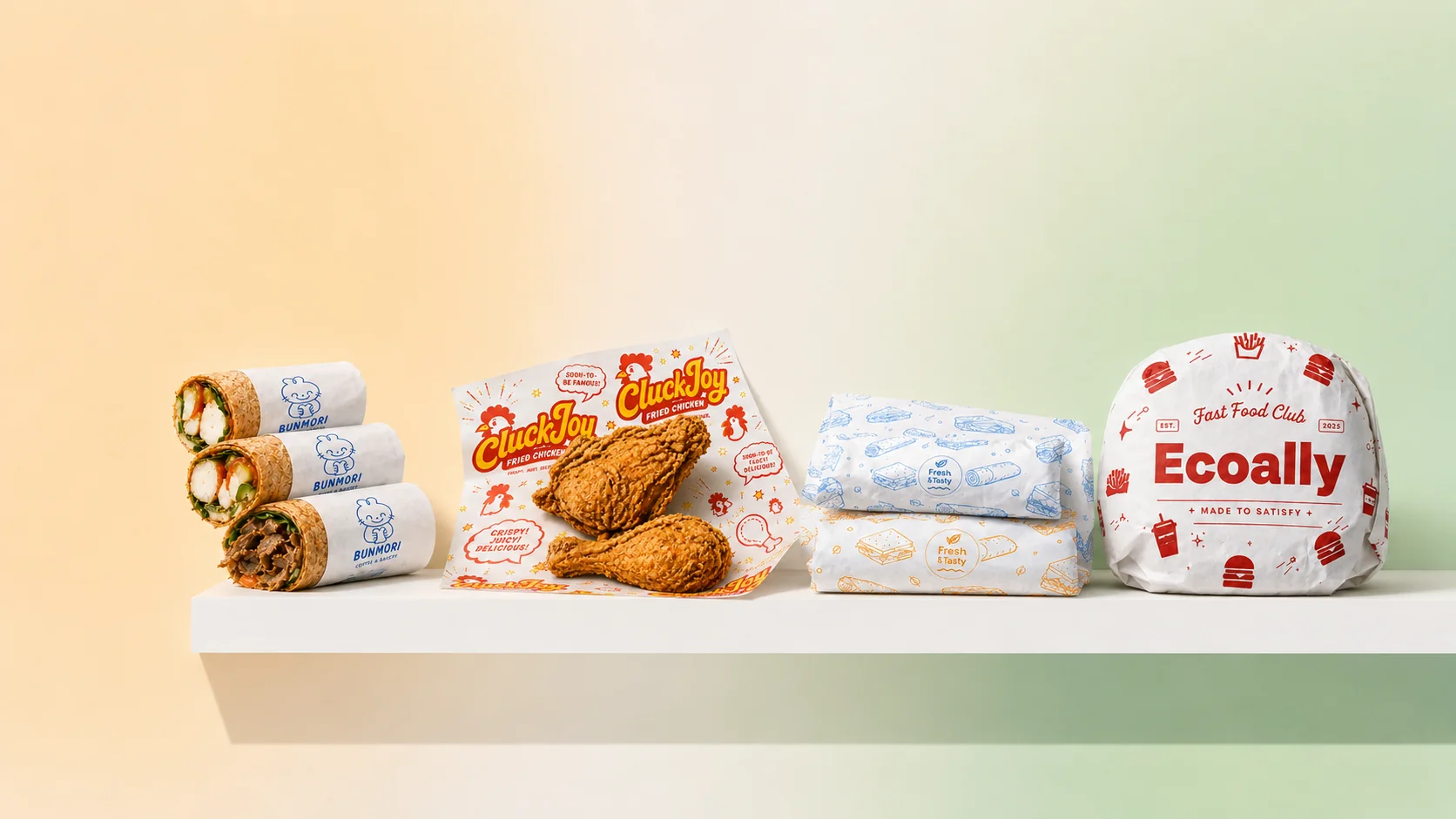
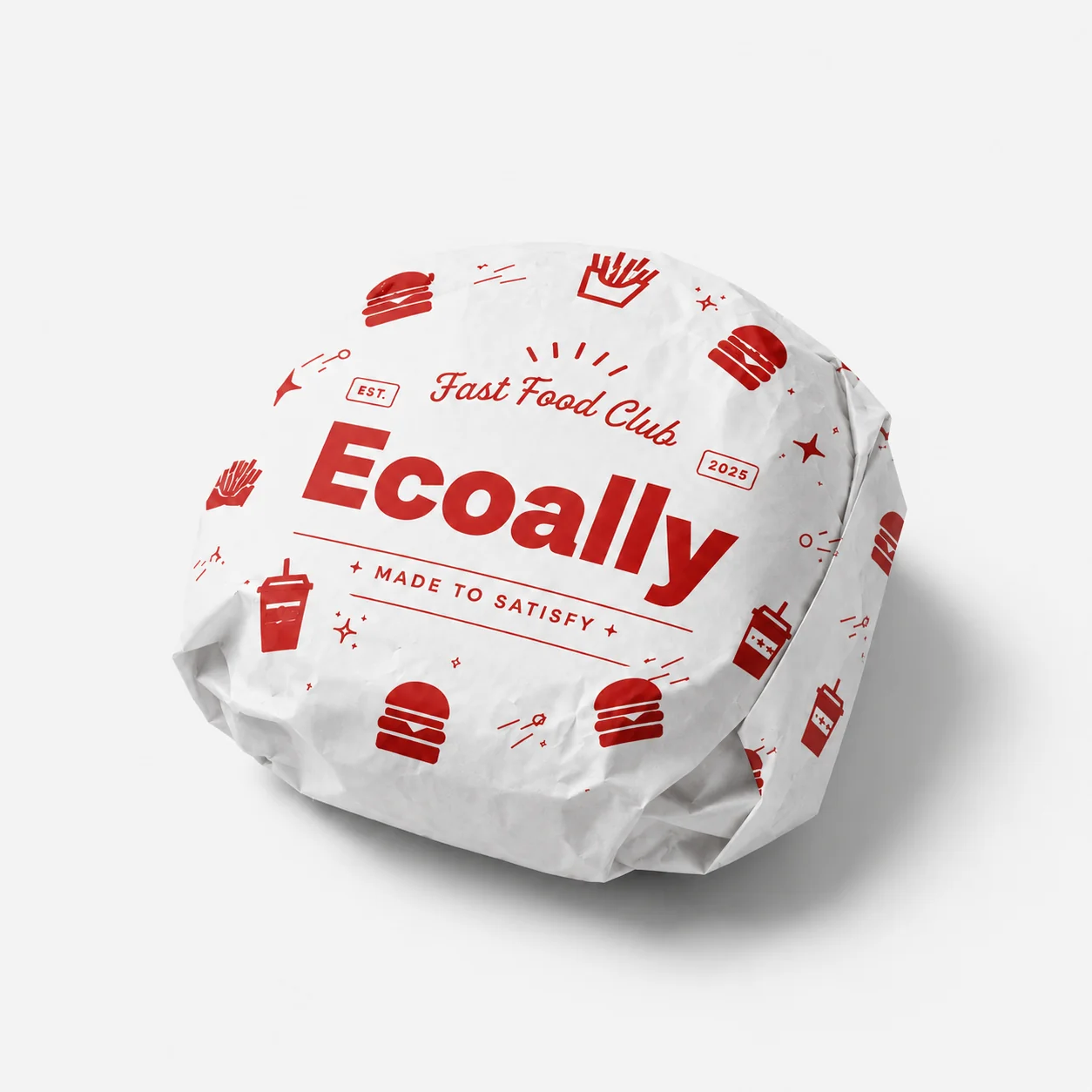
Kraft versus white is a look, not a performance difference. Both come as the same greaseproof base; kraft reads rustic and hides minor grease shadows, white makes full-color artwork pop. Ecoally's custom burger wrapping paper is a 38 gsm uncoated greaseproof sheet in either kraft or white, printed on one face only, so the surface touching the bun carries no ink.
Greaseproof vs Foil-Lined vs Wax: Which Wrap Fits Your Menu
The choice comes down to how hot and wet the burger is and how long it waits before someone eats it.
Greaseproof paper is right for counter service, food trucks, and short takeout runs. It breathes, so buns stay closer to their fresh texture instead of steaming, and it costs the least. A smash burger or a classic single eaten within 10–15 minutes wants nothing more.
Foil-lined paper is right for cheeseburgers, doubles with sauce, and anything going into a delivery bag for 20 minutes or longer. Foil reflects heat back into the sandwich, holds steam so cheese finishes melting, and stops even the heaviest sauce from reaching the outer bag. This is the reason Five Guys wraps in foil: the chain says it keeps the burger hotter and fresher on the way to the customer, and the trapped heat melts the cheese and softens the bun into the texture the brand is known for. The trade-off is the same one every foil user accepts: a wrapped bun steams, so crisp toasted edges fade, and the foil laminate is not accepted by most paper recycling programs. Ecoally's custom foil-lined paper pairs a silver foil interior with a white paper exterior at 50 gsm, printed on the paper side, and comes in the same eleven sizes as the plain greaseproof sheet.
Wax paper belongs on the cold side of the menu. A waxed sheet around a hot patty softens and can leave a waxy feel on the bun, which is why "wax burger paper" sold online is usually greaseproof paper under a misleading name. Use true wax for cold sandwiches, wraps, and pastry, and read our wax paper guide before ordering anything labeled wax for hot food.
A practical rule: one greaseproof sheet for dine-in and counter pickup, foil-lined for delivery and cheese-heavy builds, and the same artwork on both so the brand stays consistent across channels.
What Size Burger Wrapping Paper Should You Use?
Wrap sheets are square or nearly square because kitchens wrap on the diagonal: the sheet is laid as a diamond and the corners fold over the burger, so the usable length is the diagonal, not the side. A 12 × 12 in sheet gives a 17-inch diagonal, a 15 × 15 in sheet gives 21 inches.
| Sheet size | Diagonal | Fits |
|---|---|---|
| 10 × 10 in | 14 in | Sliders, 3–4 in single patties, kids' burgers |
| 12 × 12 in | 17 in | The standard: 4–4.5 in singles and most cheeseburgers |
| 10 × 12 in, 12 × 16.5 in | 16–20 in | Long sandwiches, hoagies, hot dogs, chicken sandwiches |
| 15 × 15 in | 21 in | Doubles, smash-burger stacks, loaded builds over 3 in tall |
| 16 × 18 in, 20 × 20 in | 24–28 in | Basket and tray liners, family-size wraps, sharing platters |
To check your own build, measure the burger's diameter plus its height, double the total, and pick the sheet whose diagonal clears it with an inch to spare for the tuck. A 4.5 in wide, 2.5 in tall single needs about 14 inches, so 12 × 12 works with room; a 3.5 in tall double needs 16 inches, which is why doubles move up to 15 × 15. Most shops settle on one size for burgers and one larger sheet for baskets. Ecoally's greaseproof and foil-lined sheets both come in eleven sizes from 6 × 6 in to 20 × 20 in, so the same print file covers wraps, liners, and sandwich sheets.
How to Wrap a Burger in Paper: The Three Folds Kitchens Use
Speed and a clean look come from doing the same fold every time. Print the artwork so it lands on the outside of the finished wrap, with the food touching the unprinted face.
1. The full wrap (diamond fold)
The standard takeout and delivery wrap, and the fold that lets you cut a burger in half without it falling apart.
- Lay the sheet as a diamond, printed side down, and set the burger in the center.
- Fold the bottom corner up and over the top of the burger, pulling it snug.
- Fold the left corner across, then the right corner across, so they overlap on top.
- Fold the remaining top corner down and tuck it under the burger, or flip the burger so the seam sits underneath.
- For a half-cut presentation, slice straight through the wrapped burger with a serrated knife; the paper holds each half together.
2. The half wrap (open-top cradle)
The counter-service fold made famous by West Coast burger chains. It leaves the top of the burger visible, keeps hands clean, and photographs well.
- Fold the square sheet in half into a triangle, then fold a 1-inch band along the long edge to make a "waistband."
- Set the burger on the band, centered along the long edge.
- Wrap the left and right corners around the back of the burger, slipping one inside the other.
- Fold the bottom corner up under the burger and tuck the tip into the waistband.
3. The foil wrap
Same diamond fold as the full wrap, with two changes: the foil face goes inside, and the seam stays loosely folded on top rather than crimped airtight. A small vent lets steam escape so the bun stays soft instead of wet. Wrap while the burger is hot so the cheese finishes melting in the foil.
New staff learn any of these in a shift. The variable that most affects speed is the paper itself: a 35–45 gsm greaseproof sheet creases and stays put, while very thin sheets tear at the tuck and thick ones spring open.
What Custom Burger Wrapping Paper Costs in 2026
Surveying published US prices in September 2026, printed burger wrap paper lands in a narrow band once the discount banners are stripped away:
| Route | Typical price per sheet | Notes |
|---|---|---|
| Online custom printers, 1,000–5,000 sheets | $0.10–$0.50 | Most quote minimums of 500–1,000 sheets; the low end is one-color kraft, the high end full-color or foil |
| Small-run printers, 250–500 sheets | $0.40–$0.90 | A first order at this size costs $100–$250 total, which is the realistic entry point for one location |
| Plain unprinted greaseproof, bulk | $0.02–$0.05 | Store-brand sheets from restaurant suppliers; the baseline printing is added to |
As a live example, Ecoally's greaseproof burger wrap in kraft or white with one-color print runs about $0.79 per 12 × 12 in sheet at 250, $0.41 at 500, $0.23 at 1,000, $0.14 at 2,000, $0.10 at 5,000, and $0.08 at 10,000. Full-color print adds roughly one to five cents per sheet across the same tiers, and the smaller 10 × 10 in sheet lands at about $0.76 at 250 and $0.06 at 10,000. Foil-lined sheets cost more because of the laminate: 12 × 12 in one-color runs about $1.27 at 250, $0.66 at 500, $0.36 at 1,000, $0.23 at 2,000, $0.17 at 5,000, and $0.13 at 10,000. Every size and quantity is priced on the product pages, and orders start at 250 sheets.
The per-burger math settles most debates. At 2,000 burgers a month, a printed greaseproof wrap at $0.10–$0.14 adds $200–$280 to monthly packaging, about one percent of sales for a $12 burger, and replaces a plain sheet that already cost $0.03–$0.05. Foil-lined at $0.17–$0.23 is a delivery-channel decision: worth it where the burger travels, unnecessary at the counter. Ordering logic for any packaging item is the same as we lay out in low-MOQ custom packaging: start at the smallest tier, confirm the sheet on your actual menu, then step up once the artwork stops changing.
Design and Printing Rules for Burger Wraps
- Design for the fold, not the flat sheet. On a full wrap, most of the sheet ends up hidden or creased. A repeating pattern of the logo or wordmark shows the brand from any angle; a single centered logo often disappears into the tuck. If you use a single mark, place it for the half wrap, roughly a third of the way in from one corner, where the open-top fold displays it.
- One color goes a long way on kraft. A single dark ink on kraft is the lowest-cost option, hides grease shadows, and reads as intentional. Full color earns its small premium on white paper for illustrated patterns or multi-color logos.
- Print outside, food inside. Ask the supplier which face is printed and specify that the unprinted face touches the food. Water-based inks are the norm for food papers; confirm it in writing.
- Ask about PFAS. A growing list of US states restricts PFAS in food packaging, and grease resistance in some papers historically came from those treatments. Specify PFAS-free grease resistance, achieved by refining the paper rather than coating it.
- Proof at actual size. A 12 × 12 in sheet folded around a burger shows artwork at roughly 4 inches across. Text under about 10 pt becomes decoration, so keep taglines short and let the logo carry the sheet.
- Keep one file for wraps and liners. Since greaseproof and foil-lined sheets come in the same sizes, one artwork file can cover the burger wrap, basket liner, and sandwich sheet; only the size and stock change.
Food Safety and Disposal
Uncoated greaseproof paper contains no plastic film and no wax, which is why it is the default in programs that accept soiled paper for composting and why clean sheets go into paper recycling where that is accepted locally. Foil-lined paper trades that away for heat retention: most curbside programs do not take foil-laminated paper, so it belongs in the trash unless a local program says otherwise. Wax paper is neither recyclable nor accepted by most composters. For a menu that markets sustainability, greaseproof for the counter and foil only for delivery is the honest split, and our greaseproof vs. parchment guide covers the material questions in more depth.
Pairing Wraps With Boxes, Bags, and Liners
A wrap rarely travels alone. The common combinations:
- Wrap plus paper bag. The classic counter setup: wrapped burger and a fry bag dropped into an SOS paper bag. For delivery, a foil-lined SOS bag keeps the whole order warm.
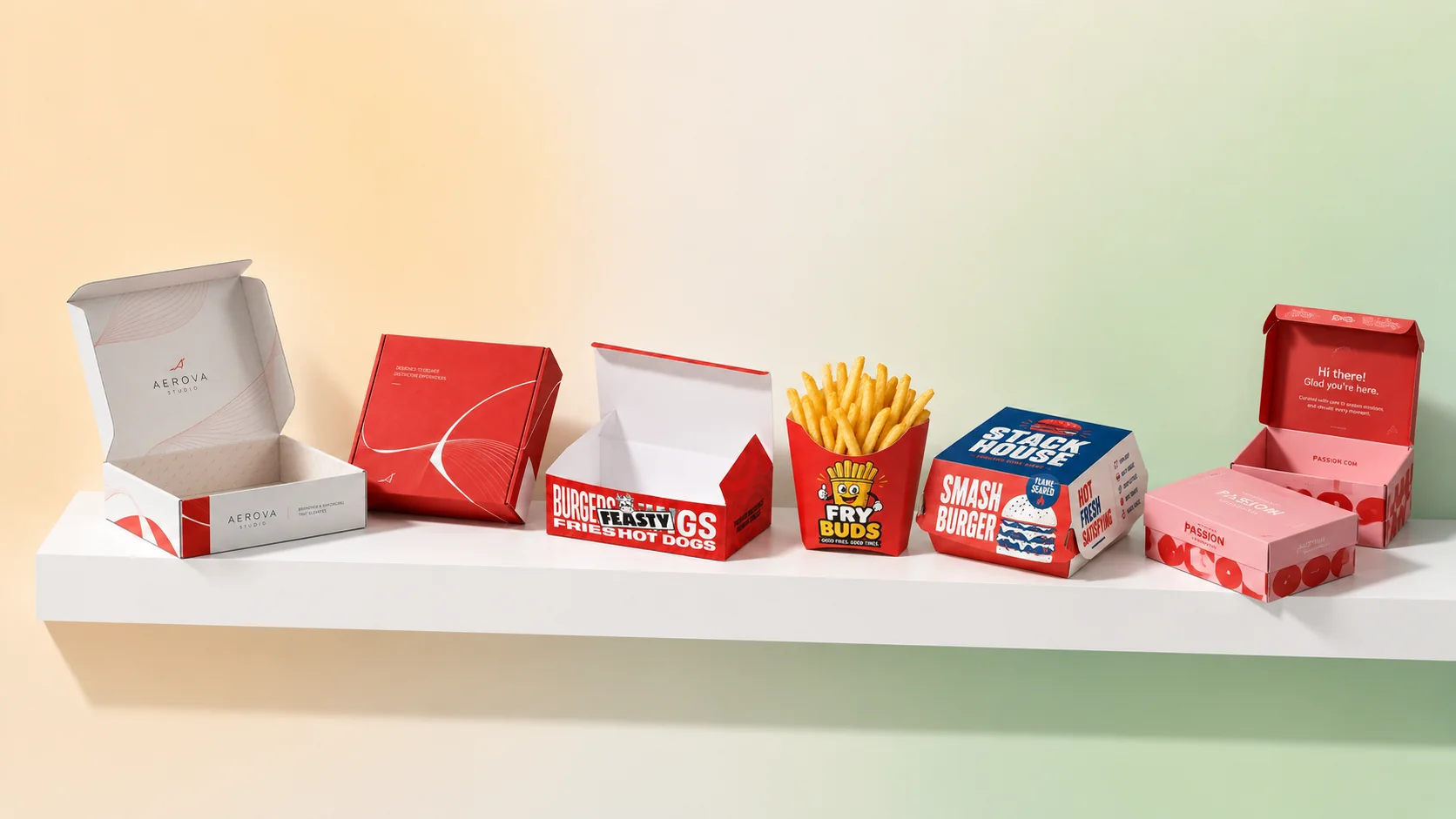
- Wrap inside a box. Premium and delivery-heavy shops wrap the burger and box it, which protects toppings from getting crushed. Sizing and board choices are in the custom burger boxes guide, and the custom burger boxes themselves come vented to keep buns from steaming.
- Liner in a basket or tray. The same greaseproof sheet in 15 × 15 in or larger lines baskets and trays for dine-in, so the brand appears under the fries as well as around the burger.
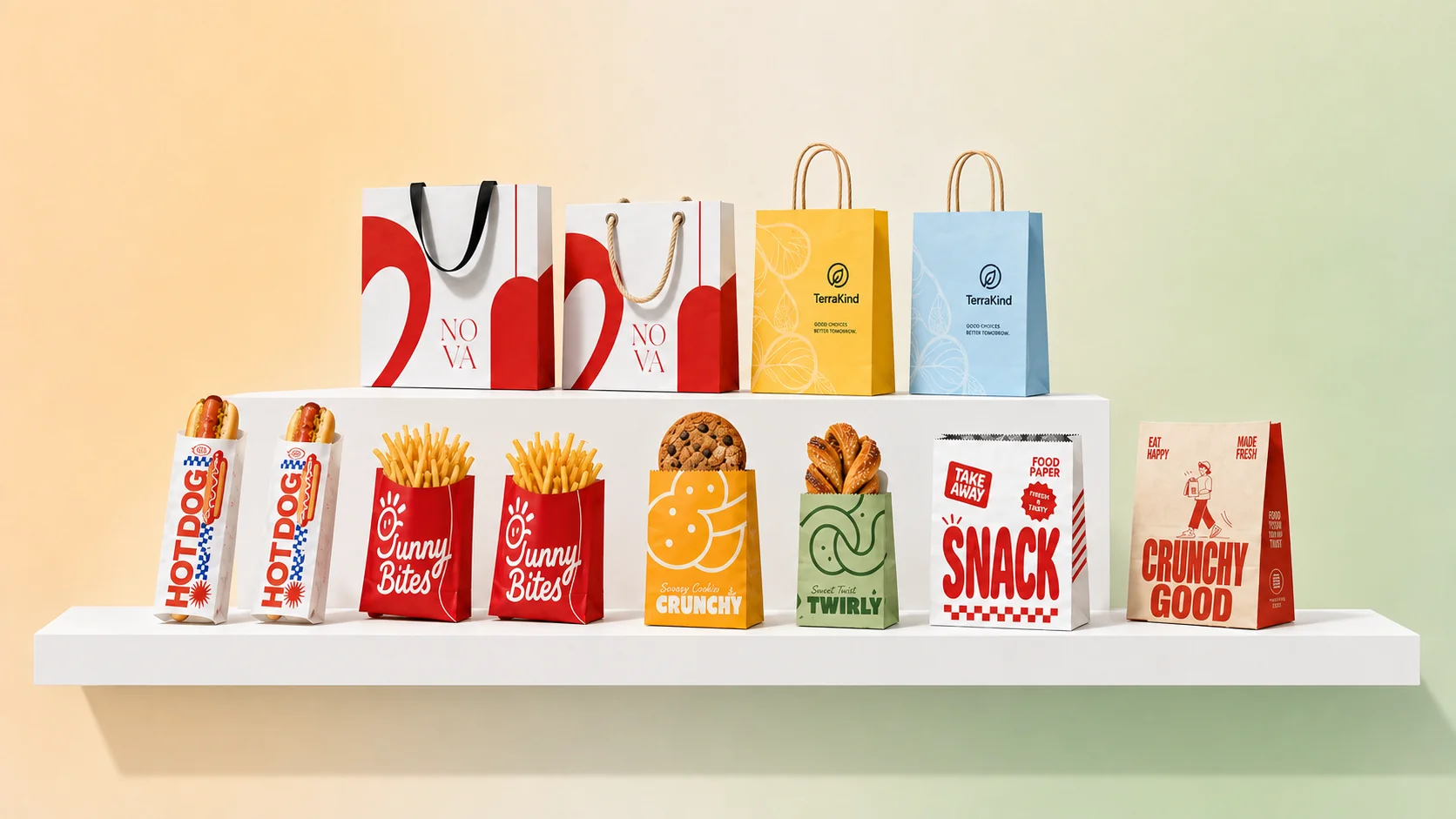
- Fries and sides. Custom fry bags and sandwich bags in matching artwork complete the set without adding a second print job.
The wider takeout picture, container by container, is in our restaurant takeout packaging guide.
Frequently Asked Questions
What type of paper is used to wrap burgers?
Most burger shops use greaseproof paper: a densely refined, uncoated sheet of about 35–45 gsm that resists oil without a plastic film and folds cleanly. Delivery-focused shops and chains that want cheese fully melted use foil-lined paper, which is thin aluminum foil laminated to paper. Wax paper is used for cold sandwiches rather than hot burgers because the wax softens with heat.
What size burger wrapping paper should I use?
12 × 12 in is the standard sheet for a single-patty burger of 4–4.5 inches; it wraps on the diagonal with room to tuck. Doubles and loaded burgers over 3 inches tall move up to 15 × 15 in, sliders fit 10 × 10 in, and long sandwiches or hot dogs use 10 × 12 in or 12 × 16.5 in. Measure diameter plus height, double it, and choose the sheet whose diagonal clears that number.
Why do Five Guys wrap burgers in foil?
Five Guys says foil keeps the burger hotter and fresher between the grill and the customer. Foil reflects heat back into the sandwich and traps steam, which melts the cheese and softens the bun, and it stops sauce from soaking the bag. The downside is a softer bun, which is why counter-service shops that prize a toasted edge stay with breathable greaseproof paper.
What is the 4-5-6 burger rule?
It is a cooking guideline, not a packaging one: cook the patty 4 minutes on the first side, 5 minutes on the second, and rest it 6 minutes, the stovetop version of the grill's 5-6-7 rule for a medium burger. The rest step is where the wrap matters. Wrapping a hot burger in greaseproof or foil-lined paper holds the temperature during that rest and finishes melting the cheese.
Can I use wax paper to wrap hot burgers?
Not ideally. True wax paper softens against a hot patty and can leave a waxy feel on the bun. Most "wax burger paper" sold for restaurants is actually greaseproof paper, which handles heat and oil. If the listing says waxed, ask whether it is a true wax coating or a greaseproof sheet before ordering it for hot food.
How much does custom burger wrapping paper cost?
In 2026, printed greaseproof burger paper from US online printers runs about $0.10–$0.50 per sheet at 1,000–5,000 sheets and $0.40–$0.90 for small first runs of 250–500. Ecoally's 12 × 12 in one-color sheet is about $0.79 at 250 and $0.08 at 10,000; foil-lined paper is about 60% more at each tier.
What is the minimum order for custom burger paper?
Many printers set minimums of 500–1,000 sheets, and some offer no minimum at higher unit prices. Ecoally prints greaseproof and foil-lined burger paper from 250 sheets, with prices stepping down through 500, 1,000, 2,000, 5,000, and 10,000.
Put the Brand on the Wrap Customers Unfold
Choose greaseproof for the counter and foil-lined for delivery, size the sheet by the burger's diagonal, print a pattern that survives the fold, and start at 250 sheets so the first run costs less than a night's receipts. Upload your artwork to Ecoally's custom burger wrapping paper page, preview it on the sheet, and order the size that fits your build before scaling to the tiers where each wrap costs a few cents.